 |
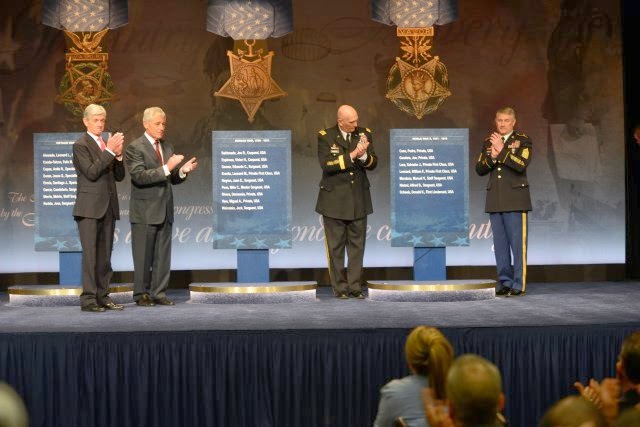
| President Barack Obama awarded 24 Medals of Honor during a ceremony in
the East Room of the White House, March 18, 2014. (Official White House
Photo by Chuck Kennedy) |
East Room
3:33 P.M. EDT
THE PRESIDENT: Good afternoon, everybody. Please be seated. Well, welcome to the White House.
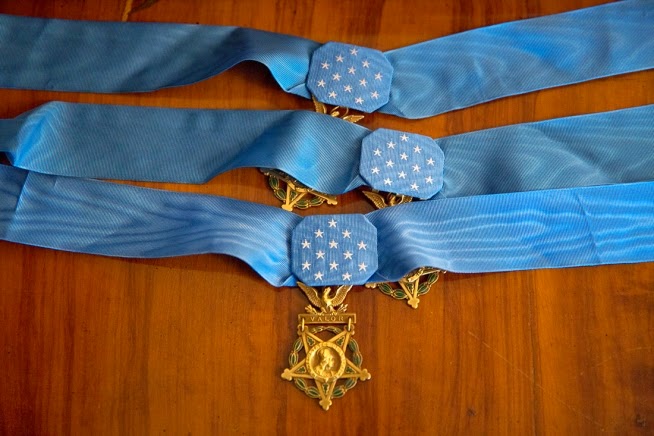
The presentation of our nation’s highest military decoration -- the Medal of Honor -- is always a special occasion. But today, it is truly historic. This is the single largest group of servicemembers to be awarded the Medal of Honor since the Second World War. And with several of these soldiers recognized for their valor during that war, this ceremony is 70 years in the making. As one family member has said, this is long overdue.
Many of these families -- and I had a chance to meet all of them who are present here today -- they’ve known these stories of heroism for decades. Still, they were pretty surprised when we called them to break the news about the Medal of Honor. Some of them thought it was a prank. (Laughter.) Some of them thought it was a scam. A few of them thought it might be some trick to get their credit card number. (Laughter.) When I called Melvin Morris -- who we’ll recognize in a moment for his actions in Vietnam -- his first reaction was, “Oh, my God, what have I done?” (Laughter.) When I told him it was all good -- the Medal of Honor -- I could hear through the phone, he almost passed out. (Laughter.)
You see, for their gallantry under fire each of these soldiers was long ago recognized with the Army’s second-highest award -- the Distinguished Service Cross. But ask their fellow veterans, ask their families, and they’ll tell you that their extraordinary deeds merited the highest recognition. And today, we have the chance to set the record straight.
This ceremony reminds us of one of the enduring qualities that makes America great -- that makes us exceptional. No nation is perfect, but here in America we confront our imperfections and face a sometimes painful past -- including the truth that some of these soldiers fought, and died, for a country that did not always see them as equal. So with each generation we keep on striving to live up to our ideals of freedom and equality, and to recognize the dignity and patriotism of every person, no matter who they are, what they look like, or how they pray.
And that’s why, more than a decade ago, Congress mandated a review to make sure that the heroism of our veterans wasn’t overlooked because of prejudice or discrimination. Our military reviewed thousands of war records. They teamed up with veterans groups and museums to get this right. It was painstaking work, made even harder because sometimes our servicemembers felt as if they needed to change their last names to fit in. That tells a story about our past. But, ultimately, after years of review, these two dozen soldiers -- among them Hispanic, African American and Jewish veterans -- were identified as having earned the Medal of Honor. This is the length to which America will go to make sure everyone who serves under our proud flag receives the thanks that they deserve.
So this is going to be a long ceremony. We’re going to read all 24 citations, because every one is a story of bravery that deserves to be told. But first, I want to take just a few minutes to describe the Americans behind these actions, the men these families know -- the brilliant lives behind the smiling faces in those old photographs, and how they reflected all the beauty and diversity of the country that they served.
They were Americans by birth and Americans by choice -- immigrants, including one who was not yet even a citizen. They grew up in big city neighborhoods like Brooklyn, rural communities like Hooper, Nebraska, small towns in Puerto Rico. They loved to fish and play baseball. They were sons who made their parents proud, and brothers who their siblings looked up to. They were so young -- many in their early 20s. And when their country went to war, they answered the call. They put on the uniform, and hugged their families goodbye -- some of them hugged the wives and children that they’d never see again.
They fought in the rocky hills of Italy, the blood-stained beaches of France, in the freezing mountains of Korea, the humid jungles of Vietnam. Their courage almost defies imagination. When you read the records of these individuals, it's unimaginable, the valor that they displayed. Running into bullets. Charging machine gun nests and climbing aboard tanks and taking them out. Covering their comrades so they could make it to safety. Holding back enemies, wave after wave, even when the combat was hand-to-hand. Manning their posts -- some to their very last breaths -- so that their comrades might live.
Of the 24 American soldiers we honor today, 10 never came home. One of them -- Corporal Joe Baldonado, from the Korean War -- is still missing, reminding us that, as a nation, we have a scared obligation to keep working to give the families of our missing servicemembers from all wars a full accounting of their loved ones.
Through their grief, the families of our fallen summoned the strength to carry on: wives whose hearts ached for their husbands; sons and daughters who grew up without their dad; nieces and nephews and grandchildren. These families join us here today. And they know, more than most, that because others laid down their lives for us, we’ve been able to live our lives in freedom, pursue our dreams. So there’s a legacy here born of sacrifice.
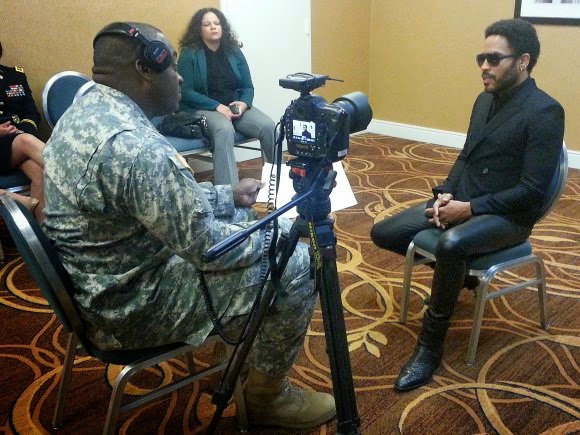
That includes a soldier’s nephew -- a kid from New York, who grew up to become one of the great rock stars of all time and who honors his uncle here today. It includes soldiers who came home and took different paths -- some continued to serve in uniform, some beginning new careers, some getting married and raising their kids, serving their communities, taking care of their fellow vets.
These veterans lived out their lives in the country that they helped to defend, and doing what they loved --like William Leonard, who at age 71 passed away in his backyard, sitting in his chair, listening to his beloved Yankees play on the radio.
And that’s where this story might have ended. But Mitchel Libman -- a friend of one of these soldiers and an Army vet himself -- set out on a mission. He and his wife Marilyn spent years writing letters and working with Congress and our military to get this done. And so we thank all those who worked so hard for so long to bring us to this moment, especially Marilyn and Mitchel -- now 83 years old -- who I’d ask to stand so that we can all say thank you. (Applause.)
Finally, of these 24 soldiers, three remain with us and have joined us here today -- men who remind us that sometimes the heroes we seek are right in front of us, literally living right next door.
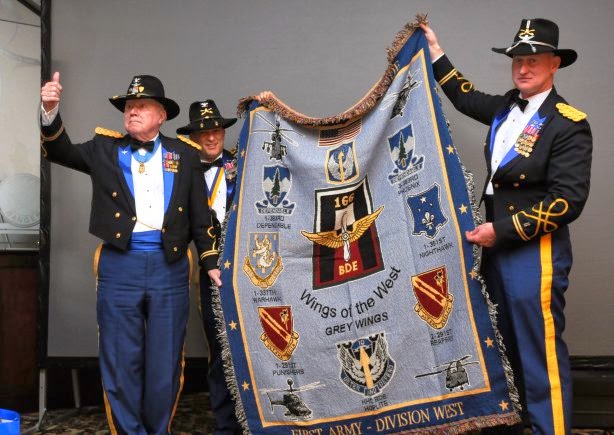
Most days, you can find Jose Rodela in his San Antonio home -- a 76-year-old retiree who enjoys watching baseball on TV, and working on his 1975 Chevy pickup, and mowing the grass for his neighbors. Jose is such a humble guy that he did not even mention the ceremony to his neighbors -- who I think would be pretty shocked to turn on the news tonight -- (laughter) -- and see that the guy who cuts their lawn is getting the Medal of Honor. (Laughter.) Today, we remember how 32--year-old Sergeant First Class Rodela fought through his wounds in Vietnam and rallied his men during 18 hours of constant combat.
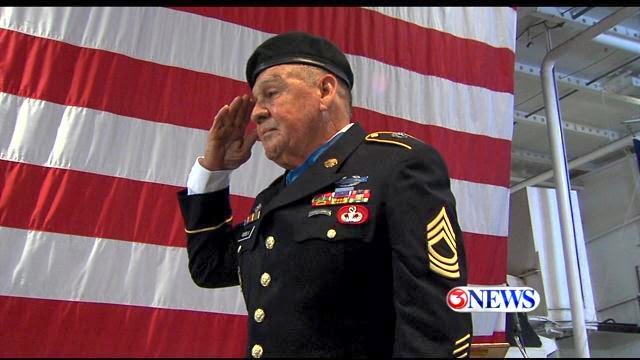
Most days, you can find Melvin Morris at home in Port St. John, Florida -- 72 years old, a retired salesman and a great-grandfather. You’ll find him working on his boat, going fishing, reading the Bible, spending time with his beautiful wife Mary -- married 53 years this month. You're going to have to give me some tips. (Laughter.) We're not that far along yet. Today, we remember how 27-year-old Staff Sergeant Morris -- one of our nation’s very first Green Berets -- one of our very first Green Berets -- think about that. I mean, that's legendary -- how Staff Sergeant Morris recovered a fallen comrade in Vietnam, took out several enemy bunkers, and kept going even after he was shot three times.
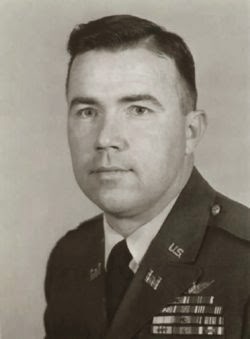
And on most days, you can find Santiago Erevia at home in San Antonio -- he’s a 68-year-old retired postal worker. He’s fixing up his house, typically, tending to the garden, going on walks with his wife, or doing some push-ups to stay in shape. (Laughter.) Today, we remember how 23-year-old Specialist Four Erevia, under a hail of bullets in Vietnam, gave first aid to his wounded comrades and single-handedly destroyed four enemy bunkers.
These are extraordinary Americans. They are exemplary soldiers. And so I want to begin by welcoming Santiago Erevia to the stage for the reading of the citation.
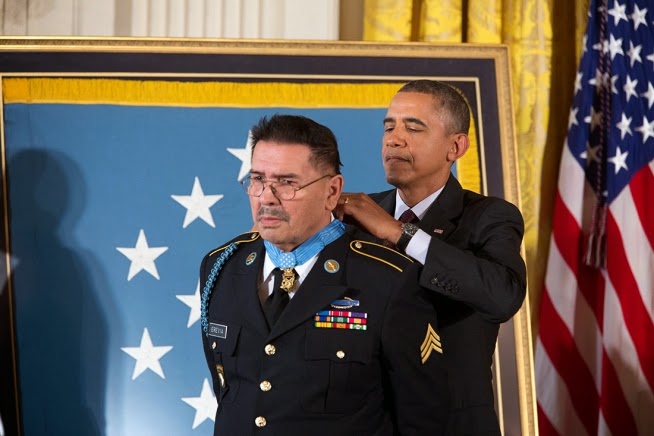 |
| President Barack Obama presents the Medal of Honor to Specialist Four
Santiago J. Erevia during the Medal of Honor ceremony in the East Room
of the White House, March 18, 2014. (Official White House Photo by
Amanda Lucidon) |
MILITARY AIDE: Specialist Four Santiago J. Erevia. United States Army. Specialist Four Santiago J. Erevia distinguished himself by acts of gallantry and intrepidity above and beyond the call of duty while serving as a radio telephone operator in Company C, 1st Battalion (Airmobile), 501st Infantry, 101st Airborne Division (Airmobile) during search and clear mission near Tam Ky, Republic of Vietnam on May 21, 1969. After breaching an insurgent perimeter, Specialist Four Erevia was designated by his platoon leader to render first aid to several casualties, and the rest of the platoon moved forward. As he was doing so, he came under intense hostile fire from four bunkers to his left front. Although he could have taken cover with the rest of the element, he chose a retaliatory course of action. With heavy enemy fire directed at him, he moved in full view of the hostile gunners as he proceeded to crawl from one wounded man to another, gathering ammunition. Armed with two M-16 rifles and several hand grenades, he charged toward the enemy positions behind the suppressive fire of the two rifles. Under very intense fire, he continued to advance on the insurgents until he was near the first bunker. Disregarding the enemy fire, he pulled the pin from a hand grenade and advanced on the bunker, leveling suppressive fire until he could drop the grenade into the bunker, mortally wounding the insurgent and destroying the fortification. Without hesitation, he employed identical tactics as he proceeded to eliminate the next two enemy positions. With the destruction of the third bunker, Specialist Four Erevia had exhausted his supply of hand grenades. Still under intense fire from the fourth position, he courageously charged forward behind the fire emitted by his M-16 rifles. Arriving at the very edge of the bunker, he silenced the occupant within the fortification at point blank range. Through his heroic actions the lives of the wounded were saved and the members of the Company Command Post were relieved from a very precarious situation. His exemplary performance in the face of overwhelming danger was an inspiration to his entire company and contributed immeasurably to the success of the mission. Specialist Four Erevia’s conspicuous gallantry, extraordinary heroism, and intrepidity at the risk of his own life, above and beyond the call of duty, were in keeping with the highest traditions of military service and reflect great credit upon himself, his unit, and the United States Army.
(The medal is presented.) (Applause.)
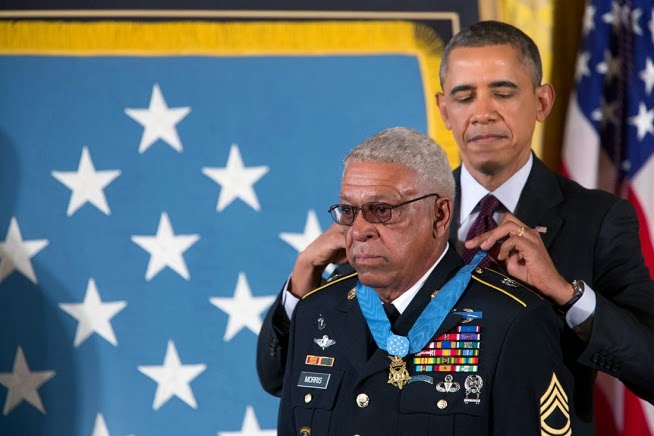 |
| President Barack Obama presents the Medal of Honor to Staff Sergeant
Melvin Morris during the Medal of Honor ceremony in the East Room of the
White House, March 18, 2014. (Official White House Photo by Amanda
Lucidon) |
MILITARY AIDE: Sergeant First Class Melvin Morris. United States Army. Staff Sergeant Melvin Morris distinguished himself by acts of gallantry and intrepidity above and beyond the call of duty while serving as Commander of a Strike Force drawn from Company D, 5th Special Forces Group (Airborne), 1st Special Forces, during combat operations against an armed enemy in the vicinity of Chi Lang, Republic of Vietnam on September 17, 1969. On that afternoon, Staff Sergeant Morris’s affiliated companies encountered an extensive enemy mine field and were subsequently engaged by a hostile force. Staff Sergeant Morris learned by radio that a fellow team commander had been killed near an enemy bunker and he immediately reorganized his men into an effective assault posture before advancing forward and splitting off with two men to recover the team commander’s body. Observing the maneuver, the hostile force concentrated its fire on Staff Sergeant Morris’s three-man element and successfully wounded both men accompanying him. After assisting the two wounded men back to his forces’ lines, Staff Sergeant Morris charged forward into withering enemy fire with only his men’s suppressive fire as cover. While enemy machine gun emplacements continuously directed strafing fusillades against him, Staff Sergeant Morris destroyed the positions with hand grenades and continued his assault, ultimately eliminating four bunkers. Upon reaching the bunker nearest the fallen team commander, Staff Sergeant Morris repulsed the enemy, retrieved his comrade and began the arduous trek back to friendly lines. He was wounded three times as he struggled forward, but ultimately succeeded in returning his fallen comrade to a friendly position. Staff Sergeant Morris’s extraordinary heroism and selflessness above and beyond the call of duty are in keeping with the highest traditions of military service and reflect great credit upon himself, his unit, and the United States Army.
(The medal is presented.) (Applause.)
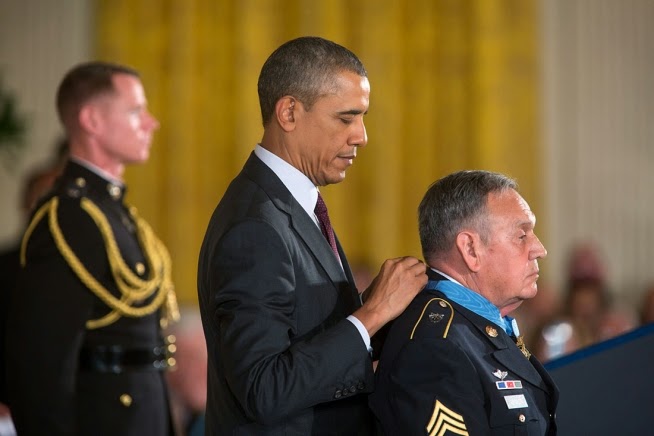 |
| President Barack Obama presents the Medal of Honor to Sergeant First
Class Jose Rodela during the Medal of Honor ceremony in the East Room of
the White House, March 18, 2014. (Official White House Photo by
Lawrence Jackson) |
MILITARY AIDE: Master Sergeant First Class Jose Rodela. United States Army. Sergeant First Class Jose Rodela distinguished himself by acts of gallantry and intrepidity above and beyond the call of duty while serving as the company commander, Detachment B-36, Company A, 5th Special Forces Group (Airborne), 1st Special Forces during combat operations against an armed enemy in Phuoc Long Province, Republic of Vietnam on September 1, 1969. That afternoon, Sergeant First Class Rodela’s battalion came under an intense barrage of mortar, rocket, and machine gun fire. Ignoring the withering enemy fire, Sergeant First Class Rodela immediately began placing his men into defensive positions to prevent the enemy from overrunning the entire battalion. Repeatedly exposing himself to enemy fire, Sergeant First Class Rodela moved from position to position, providing suppressing fire and assisting wounded, and was himself wounded in the back and head by a B-40 rocket while recovering a wounded comrade. Alone, Sergeant First Class Rodela assaulted and knocked out the B-40 rocket position before successfully returning to the battalion’s perimeter. Sergeant First Class Rodela’s extraordinary heroism and selflessness above and beyond the call of duty are in keeping with the highest traditions of military service and reflect great credit upon himself, his unit and the United States Army.
(The medal is presented.) (Applause.)
THE PRESIDENT: Before Jose returns to his seat, I just want to ask Santiago and Melvin to return to the stage, please. This is a remarkable moment. And as they come up, I’ll like to recall -- as they take their positions I'd like to recall the words of a poet:
“Tho’ much is taken, much abides; and tho’
We are not now that strength which in old days
Moved earth and heaven; that which we are, we are;
One equal temper of heroic hearts,
Made weak by time and fate, but strong in will
To strive, to seek, to find, and not to yield.”
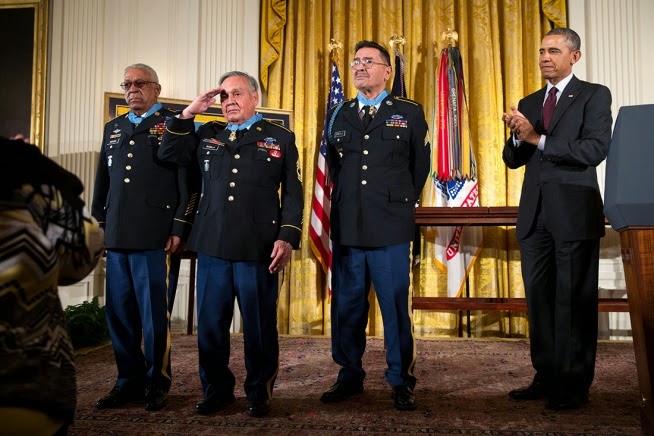 |
| President Barack Obama recognizes Medal of Honor honorees, from left,
Staff Sergeant Melvin Morris, Sergeant First Class Jose Rodela, and
Specialist Four Santiago J. Erevia, during the Medal of Honor ceremony
in the East Room of the White House, March 18, 2014. (Official White
House Photo by Pete Souza) |
Santiago Erevia, Melvin Morris, Jose Rodela -- in the thick of the fight, all those years ago, for your comrades and your country, you refused to yield. And on behalf of a grateful nation, we all want to thank you for inspiring us -- then and now -- with your strength, your will, and your heroic hearts.
Please give them a big round of applause. (Applause.)
Gentlemen, thank you. Please take your seats. We'll proceed with the rest of the ceremony.
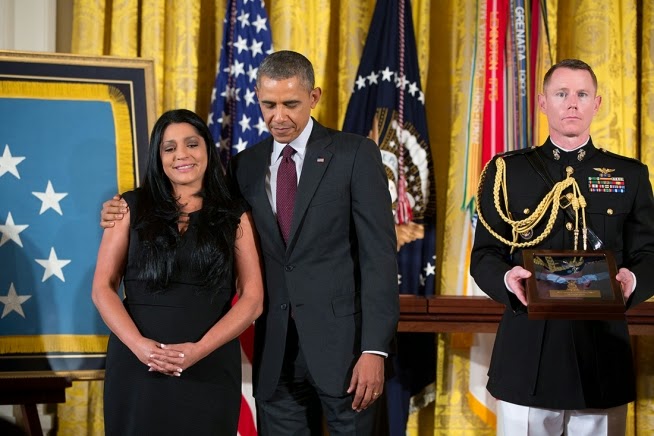 |
| President Barack Obama presents the posthumous Medal of Honor for
Specialist Four Leonard L. Alvarado during the Medal of Honor ceremony
in the East Room of the White House, March 18, 2014. The award is
accepted by his daughter Lenora Alvarado. (Official White House Photo by
Pete Souza) |
MILITARY AIDE: Lenora Alvarado accepting on behalf of her father, Specialist Four Leonard L. Alvarado.
Specialist Four Leonard L. Alvarado distinguished himself by acts of gallantry and intrepidity above and beyond the call of duty while serving as a Rifleman with Company D, 2d Battalion, 12th Cavalry, 1st Cavalry Division (Airmobile) during combat operations against an armed enemy in Phuoc Long Province, Republic of Vietnam on August 12, 1969. On that day, as Specialist Four Alvarado and a small reaction force moved through dense jungle en route to a beleaguered friendly platoon, Specialist Four Alvarado detected enemy movement and opened fire. Despite his quick reaction, Specialist Four Alvarado and his comrades were soon pinned down by the hostile force that blocked the path to the trapped platoon. Specialist Four Alvarado quickly moved forward through the hostile machinegun fire in order to engage the enemy troops. Suddenly, an enemy grenade exploded nearby, wounding and momentarily stunning him. Retaliating immediately, he killed the grenadier just as another enemy barrage wounded him again. Specialist Four Alvarado crawled forward through the fusillade to pull several comrades back within the hastily-formed perimeter. Realizing his element needed to break away from the hostile force, Specialist Four Alvarado began maneuvering forward alone. Though repeatedly thrown to the ground by exploding satchel charges, he continued advancing and firing, silencing several emplacements, including one enemy machinegun position. From his dangerous forward position, he persistently laid suppressive fire on the hostile forces, and after the enemy troops had broken contact, his comrades discovered that he had succumbed to his wounds. Specialist Four Alvarado’s extraordinary heroism and selflessness at the cost of his own life, above and beyond the call of duty, are in keeping with the highest traditions of military service and reflect great credit upon himself, his unit and the United States Army.
(The medal is presented.) (Applause.)
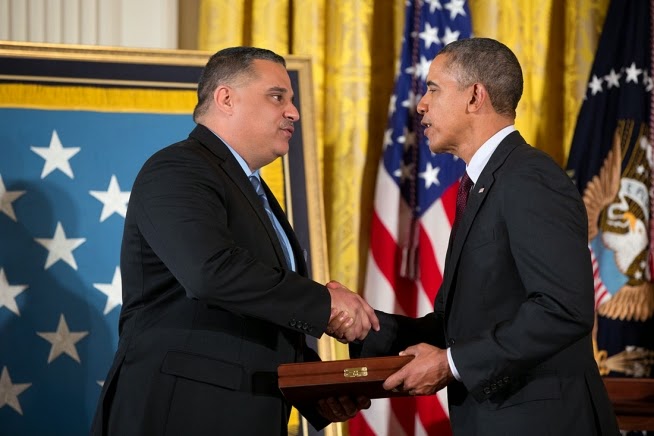 |
| President Barack Obama presents the posthumous Medal of Honor for Staff
Sergeant Felix M. Conde-Falcon during the Medal of Honor ceremony in the
East Room of the White House, March 18, 2014. The award is accepted by
his son Richard Conde. (Official White House Photo by Pete Souza) |
MILITARY AIDE: Richard Conde accepting on behalf of his father, Sergeant First Class Felix M. Conde-Falcon.
Staff Sergeant Felix M. Conde-Falcon distinguished himself by acts of gallantry and intrepidity above and beyond the call of duty while serving as an acting Platoon Leader in Company D, 1st Battalion, 505th Infantry Regiment, 3d Brigade, 82d Airborne Division during combat operations against an armed enemy in Ap Tan Hoa, Republic of Vietnam on April 4, 1969. While entering a heavily wooded section on the route of advance, Staff Sergeant Conde-Falcon and his company encountered an extensive enemy bunker complex, later identified as a battalion command post. Following tactical artillery and air strikes on the heavily-secured enemy position, Staff Sergeant Conde-Falcon’s platoon was selected to assault and clear the bunker fortifications. Moving out ahead of his platoon, Staff Sergeant Conde-Falcon charged the first bunker, heaving grenades as he went. As the hostile fire increased, he crawled to the blind side of an entrenchment position, jumped to the roof, and tossed a grenade into the bunker aperture. Without hesitating, he proceeded to two additional bunkers, both of which he destroyed in the same manner as the first. Rejoining his platoon, Staff Sergeant Conde-Falcon advanced about one hundred meters through the trees before coming under intense hostile fire. Selecting three men to accompany him, he maneuvered toward the enemy’s flank position. Carrying a machinegun, he single-handedly assaulted the nearest fortification, killing the enemy inside before running out of ammunition. After returning to the three men with his empty weapon and taking up an M-16 rifle, he concentrated on the next bunker. Within ten meters of his goal, Staff Sergeant Conde-Falcon was shot by an unseen assailant and soon died of his wounds. Staff Sergeant Conde-Falcon’s extraordinary heroism and selflessness at the cost of his own life, above and beyond the call of duty, are in keeping with the highest traditions of military service and reflect great credit upon himself, his unit and the United States Army.
(The medal is presented.) (Applause.)
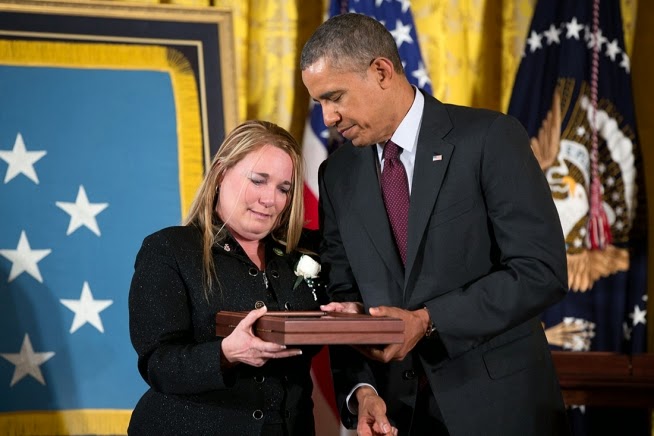 |
| President Barack Obama presents the posthumous Medal of Honor for
Specialist Four Ardie R. Copas during the Medal of Honor ceremony in the
East Room of the White House, March 18, 2014. The award is accepted by
his his daughter Shyrell Jean Copas. (Official White House Photo by Pete
Souza) |
MILITARY AIDE: Shyrell Jean Copas accepting on behalf of her father, Specialist Four Ardie R. Copas.
Specialist Four Ardie R. Copas distinguished himself by acts of gallantry and intrepidity above and beyond the call of duty while serving as a Machinegunner in Company C, 1st Battalion (Mechanized), 5th Infantry Regiment, 25th Infantry Division during combat operations against an armed enemy near Ph Romeas Hek, Cambodia on May 12, 1970. That morning, Specialist Four Copas’s company was suddenly attacked by a large hostile force firing recoilless rifles, rocket-propelled grenades, and automatic weapons. As Specialist Four Copas began returning fire, his armored car was struck by an enemy recoilless round, knocking him to the ground and injuring four American Soldiers beside the vehicle. Ignoring his own wounds, Specialist Four Copas quickly remounted the burning vehicle and commenced firing his machinegun at the belligerents. Braving the hostile fire directed at him and the possible detonation of the mortar rounds inside the track, Specialist Four Copas maintained a heavy volume of suppressive fire on the foe while the wounded Americans were safely evacuated. Undaunted, Specialist Four Copas continued to place devastating volleys of fire upon the adversary until he was mortally wounded when another enemy round hit his vehicle. Specialist Four Copas’s daring action resulted in the safe evacuation of his comrades. Specialist Four Copas’s extraordinary heroism and selflessness at the cost of his own life, above and beyond the call of duty, are in keeping with the highest traditions of military service and reflect great credit upon himself, his unit and the United States Army.
(The medal is presented.) (Applause.)
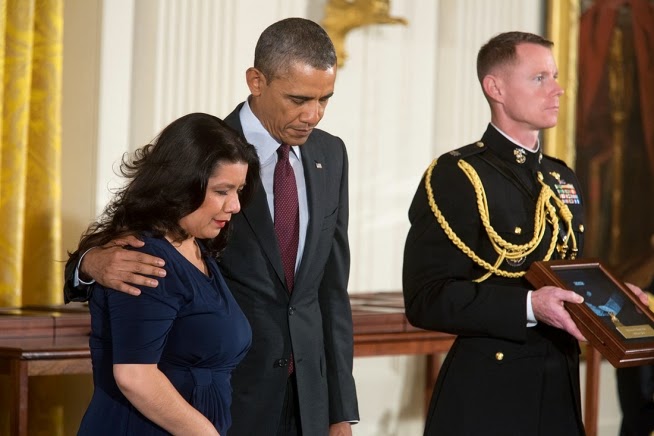 |
| President Barack Obama presents the posthumous Medal of Honor for
Specialist Four Jesus S. Duran during the Medal of Honor ceremony in the
East Room of the White House, March 18, 2014. The award is accepted by
his daughter Tina Duran-Ruvalcaba. (Official White House Photo by Chuck
Kennedy) |
MILITARY AIDE: Tina Duran-Ruvalcaba accepting on behalf of her father, Specialist Four Jesus S. Duran.
Specialist Four Jesus S. Duran distinguished himself by acts of gallantry and intrepidity above and beyond the call of duty while serving as an acting M-60 machinegunner in Company E, 2d Battalion, 5th Cavalry, 1st Cavalry Division (Airmobile) during combat operations against an armed enemy in the Republic of Vietnam on April 10, 1969. That afternoon, the reconnaissance platoon was moving into an elaborate enemy bunker complex when the lead elements began taking concentrated ambush fire from every side. The command post was in imminent danger of being overrun. With an M-60 machinegun blazing from his hip, Specialist Four Duran rushed forward and assumed a defensive position near the command post. As hostile forces stormed forward, Specialist Four Duran stood tall in a cloud of dust raised by the impacting rounds and bursting grenades directed towards him and thwarted the enemy with devastating streams of machinegun fire. Learning that two seriously wounded troopers lay helplessly pinned down under harassing fire, Specialist Four Duran assaulted the suppressive enemy positions, firing deadly bursts on the run. Mounting a log, he fired directly into the enemy’s foxholes, eliminating four and cutting down several others as they fled. Specialist Four Duran then continued to pour effective fire on the disorganized and fleeing enemy. Specialist Four Duran’s extraordinary heroism and selflessness above and beyond the call of duty are in keeping with the highest traditions of military service and reflect great credit upon himself, his unit and the United States Army.
(The medal is presented.) (Applause.)
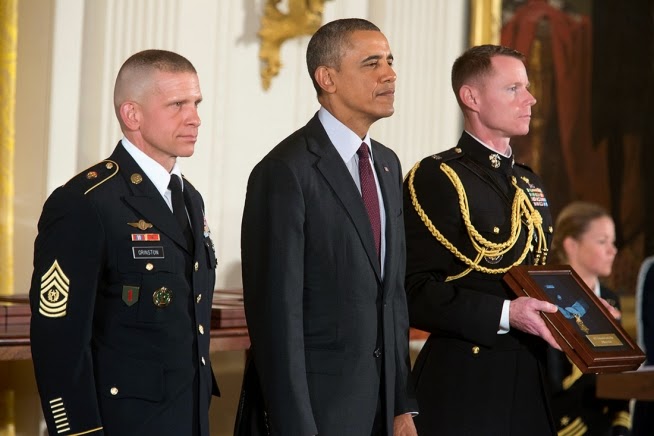 |
| President Barack Obama presents the posthumous Medal of Honor for
Sergeant Candelario Garcia during the Medal of Honor ceremony in the
East Room of the White House, March 18, 2014. The award is accepted on
his behalf by Command Sergeant Major Michael Grinston. (Official White
House Photo by Chuck Kennedy) |
MILITARY AIDE: Command Sergeant Major Michael Grinston accepting on behalf of Sergeant Candelario Garcia.
Sergeant Candelario Garcia distinguished himself by acts of gallantry and intrepidity above and beyond the call of duty while serving as an acting Team Leader for Company B, 1st Battalion, 2d Infantry, 1st Brigade,1st Infantry Division during combat operations against an armed enemy in Lai Khe, Republic of Vietnam on December 8, 1968. On that day, while conducting reconnaissance, Sergeant Garcia and his platoon discovered communication wire and other signs of an enemy base camp leading into a densely vegetated area. As the men advanced, they came under intense fire. Several men were hit and trapped in the open. Ignoring a hail of hostile bullets, Sergeant Garcia crawled to within ten meters of a machinegun bunker, leaped to his feet and ran directly at the fortification, firing his rifle as he charged. Sergeant Garcia jammed two hand grenades into the gun port and then placed the muzzle of his weapon inside, killing all four occupants. Continuing to expose himself to intense enemy fire, Sergeant Garcia raced fifteen meters to another bunker and killed its three defenders with hand grenades and rifle fire. After again braving the enemies’ barrage in order to rescue two casualties, he joined his company in an assault which overran the remaining enemy positions. Sergeant Garcia’s extraordinary heroism and selflessness above and beyond the call of duty are in keeping with the highest traditions of military service and reflect great credit upon himself, his unit and the United States Army.
(The medal is presented.) (Applause.)
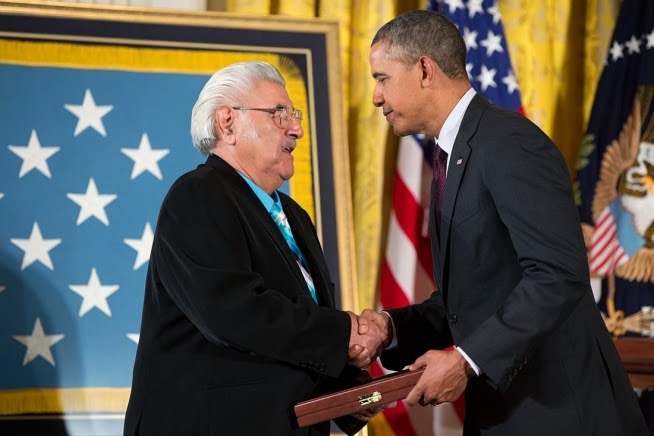 |
| President Barack Obama presents the posthumous Medal of Honor for
Corporal Joe R. Baldonado during the Medal of Honor ceremony in the East
Room of the White House, March 18, 2014. The award is accepted on his
behalf by his brother Charles Baldonado. (Official White House Photo by
Pete Souza) |
MILITARY AIDE: Charles Baldonado accepting on behalf of his brother, Corporal Joe R. Baldonado
Corporal Joe R. Baldonado distinguished himself by acts of gallantry and intrepidity above and beyond the call of duty while serving as an acting machinegunner in 3d Squad, 2d Platoon, Company B, 187th Airborne Infantry Regiment during combat operations against an armed enemy in Kangdong, Korea on November 25, 1950. On that morning, the enemy launched a strong attack in an effort to seize the hill occupied by Corporal Baldonado and his company. The platoon had expended most of its ammunition in repelling the enemy attack and the platoon leader decided to commit his 3d Squad, with its supply of ammunition, in the defensive action. Since there was no time to dig in because of the proximity of the enemy, who had advanced to within twenty-five yards of the platoon position, Corporal Baldonado emplaced his weapon in an exposed position and delivered a withering stream of fire on the advancing enemy, causing them to fall back in disorder. The enemy then concentrated all their fire on Corporal Baldonado’s gun and attempted to knock it out by rushing the position in small groups and hurling hand grenades. Several times, grenades exploded extremely close to Corporal Baldonado but failed to interrupt his continuous firing. The hostile troops made repeated attempts to storm his position and were driven back each time with appalling casualties. The enemy finally withdrew after making a final assault on Corporal Baldonado’s position during which a grenade landed near his gun, killing him instantly. Corporal Baldonado’s extraordinary heroism and selflessness at the cost of his own life, above and beyond the call of duty, are in keeping with the highest traditions of military service and reflect great credit upon himself, his unit and the United States Army.
(The medal is presented.) (Applause.)
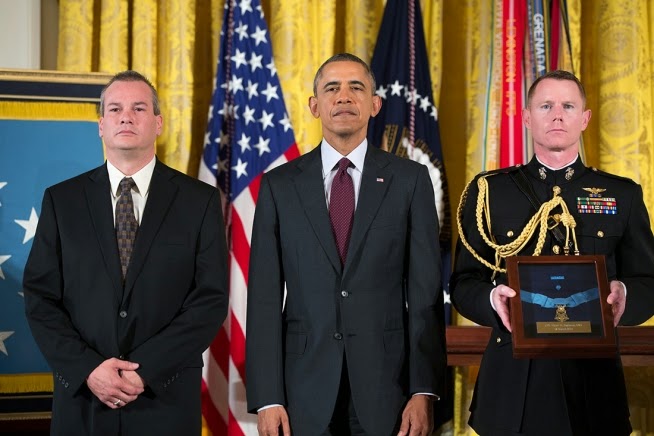 |
| President Barack Obama presents the posthumous Medal of Honor for
Corporal Victor H. Espinoza during the Medal of Honor ceremony in the
East Room of the White House, March 18, 2014. The award is accepted on
his behalf by his son Tyronne Espinoza. (Official White House Photo by
Pete Souza) |
MILITARY AIDE: Tyronne Espinoza accepting on behalf of his father, Corporal Victor H. Espinoza.
Corporal Victor H. Espinoza distinguished himself by acts of gallantry and intrepidity above and beyond the call of duty while serving as an Acting Rifleman in Company A, 23d Infantry Regiment, 2d Infantry Division during combat operations against an armed enemy in Chorwon, Korea on August 1, 1952. On that day, Corporal Espinoza and his unit were responsible for securing and holding a vital enemy hill. As the friendly unit neared its objective, it was subjected to a devastating volume of enemy fire, slowing its progress. Corporal Espinoza, unhesitatingly and being fully aware of the hazards involved, left his place of comparative safety and made a deliberate one man assault on the enemy with his rifle and grenades, destroying a machinegun and killing its crew. Corporal Espinoza continued across the fire-swept terrain to an exposed vantage point where he attacked an enemy mortar position and two bunkers with grenades and rifle fire, knocking out the enemy mortar position and destroying both bunkers and killing their occupants. Upon reaching the crest, and after running out of rifle ammunition, he called for more grenades. A comrade who was behind him threw some Chinese grenades to him. Immediately upon catching them, he pulled the pins and hurled them into the occupied trenches, killing and wounding more of the enemy with their own weapons. Continuing on through a tunnel, Corporal Espinoza made a daring charge, inflicting at least seven more casualties upon the enemy who were fast retreating into the tunnel. Corporal Espinoza was quickly in pursuit, but the hostile fire from the opening prevented him from overtaking the retreating enemy. As a result, Corporal Espinoza destroyed the tunnel with TNT, called for more grenades from his company, and hurled them at the enemy troops until they were out of reach. Corporal Espinoza’s incredible display of valor secured the vital strong point and took a heavy toll on the enemy, resulting in at least fourteen dead and eleven wounded. Corporal Espinoza’s extraordinary heroism and selflessness above and beyond the call of duty are in keeping with the highest traditions of military service and reflect great credit upon himself, his unit and the United States Army.
(The medal is presented.) (Applause.)
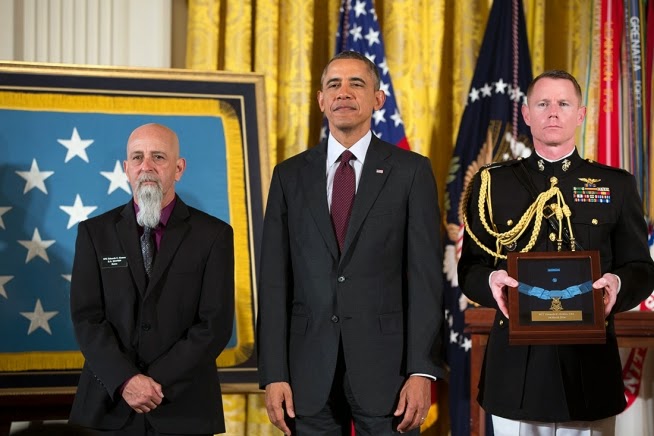 |
| President Barack Obama presents the posthumous Medal of Honor for
Sergeant Eduardo C. Gomez during the Medal of Honor ceremony in the East
Room of the White House, March 18, 2014. The award is accepted on his
behalf by his nephew Pete Corrall. (Official White House Photo by Pete
Souza) |
MILITARY AIDE: Pete Corrall accepting on behalf of his uncle, Sergeant Eduardo C. Gomez.
Sergeant Eduardo C. Gomez distinguished himself by acts of gallantry and intrepidity above and beyond the call of duty while serving with Company I, 8th Cavalry Regiment, 1st Cavalry Division during combat operations against an armed enemy in Tabu-dong, Korea on September 3, 1950. That afternoon, while conducting combat patrol, Sergeant Gomez’ company was ruthlessly attacked by a hostile force which moved within seventy-five yards of the command post before it was immobilized by rocket fire. However, an enemy tank and multiple enemy machineguns continued to rake the company perimeter with devastating fire. Realizing the tank posed a serious threat to the entire perimeter, Sergeant Gomez voluntarily crawled thirty yards across an open rice field vulnerable to enemy observation and fire, boarded the tank, pried open one of the hatches on the turret and dropped an activated grenade into the hull, killing the crew. Wounded in the left side while returning to his position, Sergeant Gomez refused evacuation. Observing that the tripod of a .30 caliber machinegun was rendered inoperable by enemy fire, he cradled the weapon in his arms, returned to the forward defensive positions, and swept the assaulting force with withering fire. Although his weapon overheated and burned his hands and his painful wound still bled, Sergeant Gomez maintained his stand and, upon orders to withdraw in the face of overwhelming enemy superiority, remained to provide protective fire. Sergeant Gomez continued to pour accurate fire into the enemy ranks, exacting a heavy toll in casualties and retarding their advance. Sergeant Gomez would not consent to leave his post for medical attention until the company established new defensive positions. Sergeant Gomez’s extraordinary heroism and selflessness above and beyond the call of duty are in keeping with the highest traditions of military service and reflect great credit upon himself, his unit and the United States Army.
(The medal is presented.) (Applause.)
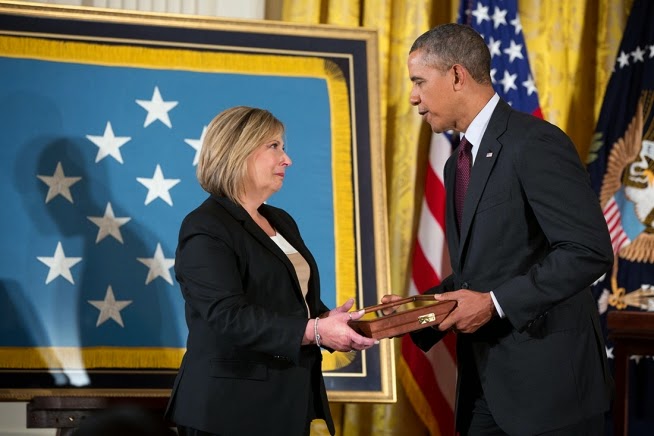 |
| President Barack Obama presents the posthumous Medal of Honor for
Private First Class Leonard M. Kravitz during the Medal of Honor
ceremony in the East Room of the White House, March 18, 2014. The award
is accepted on his behalf by his niece Laurie Wenger. (Official White
House Photo by Pete Souza) |
MILITARY AIDE: Laurie Wegner accepting on behalf of her uncle, Private First Class Leonard M. Kravitz.
Private First Class Leonard M. Kravitz distinguished himself by acts of gallantry and intrepidity above and beyond the call of duty while serving as an assistant machinegunner with Company M, 5th Infantry Regiment, 24th Infantry Division during combat operations against an armed enemy in Yangpyong, Korea on March 6 and 7, 1951. After friendly elements had repulsed two probing attacks, the enemy launched a fanatical banzai charge with heavy supporting fire and, despite staggering losses, pressed the assault with ruthless determination. When the machinegunner was wounded in the initial phase of the action, Private First Class Kravitz immediately seized the weapon and poured devastating fire into the ranks of the onrushing assailants. The enemy effected and exploited a breach on the left flank, rendering the friendly positions untenable. Upon order to withdraw, Private First Class Kravitz voluntarily remained to provide protective fire for the retiring elements. Detecting enemy troops moving toward friendly positions, Private First Class Kravitz swept the hostile soldiers with deadly, accurate fire, killing the entire group. His destructive retaliation caused the enemy to concentrate vicious fire on his position and enabled the friendly elements to withdraw. Later, after friendly troops had returned, Private First Class Kravitz was found dead behind the gun he had so heroically manned, surrounded by numerous enemy dead. Private First Class Kravitz’s extraordinary heroism and selflessness at the cost of his own life, above and beyond the call of duty, are in keeping with the highest traditions of military service and reflect great credit upon himself, his unit and the United States Army.
(The medal is presented.) (Applause.)
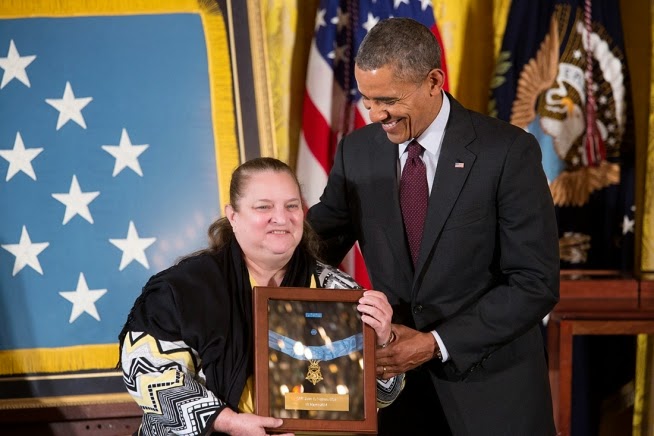 |
| President Barack Obama presents the posthumous Medal of Honor for Master
Sergeant Juan E. Negron during the Medal of Honor ceremony in the East
Room of the White House, March 18, 2014. The award is accepted on his
behalf by his daughter Iris Negron. (Official White House Photo by
Amanda Lucidon) |
MILITARY AIDE: Iris Negron accepting on behalf of her father, Sergeant Juan E. Negron.
Sergeant Juan E. Negron distinguished himself by acts of gallantry and intrepidity above and beyond the call of duty while serving as a member of Company L, 65th Infantry Regiment, 3d Infantry Division during combat operations against an armed enemy in Kalma-Eri, Korea on April 28, 1951. That afternoon, Sergeant Negron took up the most vulnerable position on his company’s exposed right flank after an enemy force had overrun a section of the line. When notified that elements of his company were withdrawing, Sergeant Negron refused to leave his exposed position, instead delivering withering fire at hostile troops who had broken through a road block. When the hostile troops approached his position, Sergeant Negron accurately hurled hand grenades at short range, halting their attack. Sergeant Negron held the position throughout the night while friendly forces organized and launched a counterattack. The next morning, after the enemy had been repulsed, friendly forces relieved Sergeant Negron and found the bodies of fifteen enemy soldiers surrounding his position. Sergeant Negron’s extraordinary heroism and selflessness above and beyond the call of duty are in keeping with the highest traditions of military service and reflect great credit upon himself, his unit and the United States Army.
(The medal is presented.) (Applause.)
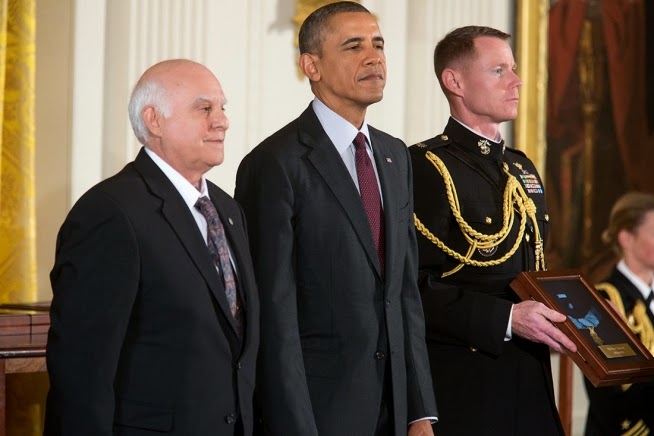 |
| President Barack Obama presents the posthumous Medal of Honor for Master
Sergeant Mike C. Pena during the Medal of Honor ceremony in the East
Room of the White House, March 18, 2014. The award is accepted on his
behalf by his son Michael David Pena. (Official White House Photo by
Chuck Kennedy) |
MILITARY AIDE: Michael David Pena accepting on behalf of his father, Master Sergeant Mike C. Pena.
Master Sergeant Mike C. Pena distinguished himself by acts of gallantry and intrepidity above and beyond the call of duty while serving as a member of Company F, 5th Cavalry Regiment, 1st Cavalry Division during combat operations against an armed enemy in Waegwan, Korea, on September 4, 1950. That evening, under cover of darkness and a dreary mist, an enemy battalion moved to within a few yards of Master Sergeant Pena’s platoon. Recognizing the enemy’s approach, Master Sergeant Pena and his men opened fire, but the enemy’s sudden emergence and accurate, point blank fire forced the friendly troops to withdraw. Master Sergeant Pena rapidly reorganized his men and led them in a counterattack which succeeded in regaining the positions they had just lost. He and his men quickly established a defensive perimeter and laid down devastating fire, but enemy troops continued to hurl themselves at the defenses in overwhelming numbers. Realizing that their scarce supply of ammunition would soon make their positions untenable, Master Sergeant Pena ordered his men to fall back and manned a machinegun to cover their withdrawal. He singlehandedly held back the enemy until the early hours of the following morning when his position was overrun and he was killed. Master Sergeant Pena’s extraordinary heroism and selflessness at the cost of his own life, above and beyond the call of duty, are in keeping with the highest traditions of military service and reflect great credit upon himself, his unit and the United States Army.
(The medal is presented.) (Applause.)
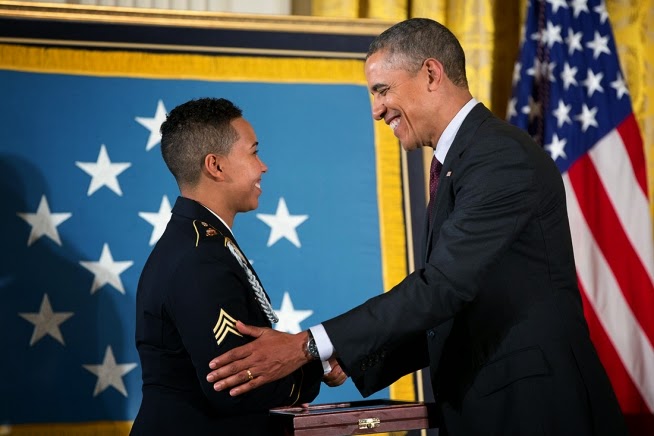 |
| President Barack Obama presents the posthumous Medal of Honor for
Private Demensio Rivera during the Medal of Honor ceremony in the East
Room of the White House, March 18, 2014. The award is accepted on his
behalf by his granddaughter Sergeant Ashley Randall. (Official White
House Photo by Pete Souza) |
MILITARY AIDE: Sergeant Ashley Randall accepting on behalf of her grandfather, Private Demensio Rivera.
Private Demensio Rivera distinguished himself by acts of gallantry and intrepidity above and beyond the call of duty while serving as an automatic rifleman with 2d Platoon, Company G, 7th Infantry Regiment, 3d Infantry Division during combat operations against an armed enemy in Changyong-ni, Korea on May 23, 1951. Early that morning, a large hostile force emerged from a dense fog and viciously attacked Private Rivera and his comrades. Private Rivera immediately responded by firing with deadly accuracy until his weapon jammed. Without hesitating, he threw his rifle down and began to engage the enemy with his pistol and grenades. At one point, Private Rivera fearlessly crawled from his emplacement to engage an infiltrating enemy soldier in fierce hand-to-hand combat. With only the sound of footsteps and obscure shadows to guide his aim, Private Rivera held his position against tremendous odds, inflicting numerous casualties on the enemy until he found himself without ammunition of any kind except one grenade. Displaying a peerless fighting spirit and an utterly selfless devotion to duty, Private Rivera pulled the pin from his last grenade and calmly waited for the enemy to reach his position. As enemy troops leaped inside his bunker, Private Rivera activated the grenade with the full knowledge that it meant his almost certain death. When the debris from the explosion had cleared, friendly forces recovered a severely wounded Private Rivera and discovered the bodies of four dead or dying enemy soldiers surrounding him. Private Rivera’s extraordinary heroism and selflessness above and beyond the call of duty are in keeping with the highest traditions of military service and reflect great credit upon himself, his unit and the United States Army.
(The medal is presented.) (Applause.)
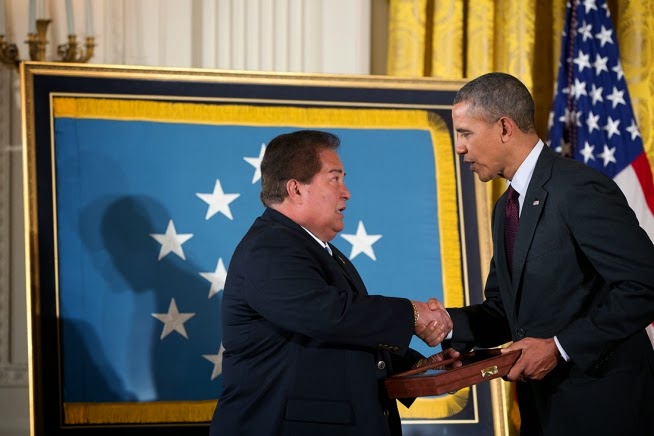 |
| President Barack Obama presents the posthumous Medal of Honor for
Private Miguel A. Vera during the Medal of Honor ceremony in the East
Room of the White House, March 18, 2014. The award is accepted on his
behalf by his nephew Joe Rodriguez. (Official White House Photo by Pete
Souza) |
MILITARY AIDE: Joe Rodriguez accepting on behalf of his uncle, Private Miguel A. Vera.
Private Miguel A. Vera distinguished himself by acts of gallantry and intrepidity above and beyond the call of duty while serving as an automatic rifleman with Company F, 38th Infantry Regiment, 2d Infantry Division in Chorwon, Korea, on September 21, 1952. That morning, despite suffering from wounds inflicted in a previous battle, Private Vera voluntarily left the aid station to join his comrades in an attack against well-fortified enemy positions on a hill of great importance. When the assaulting elements had moved within twenty yards of the enemy positions, they were suddenly trapped by a heavy volume of mortar, artillery and small-arms fire. The company prepared to make a limited withdrawal, but Private Vera volunteered to remain behind to provide covering fire. As his companions moved to safety, Private Vera remained steadfast in his position, directing accurate fire against the hostile positions despite the intense volume of fire which the enemy was concentrating upon him. Later in the morning, when the friendly force returned, they discovered Private Vera in the same position, facing the enemy. Private Vera’s noble intrepidity and self-sacrifice saved many of his comrades’ lives. Private Vera’s extraordinary heroism and selflessness at the cost of his own life, above and beyond the call of duty, are in keeping with the highest traditions of the military service and reflect great credit upon himself, his unit and the United States Army.
(The medal is presented.) (Applause.)
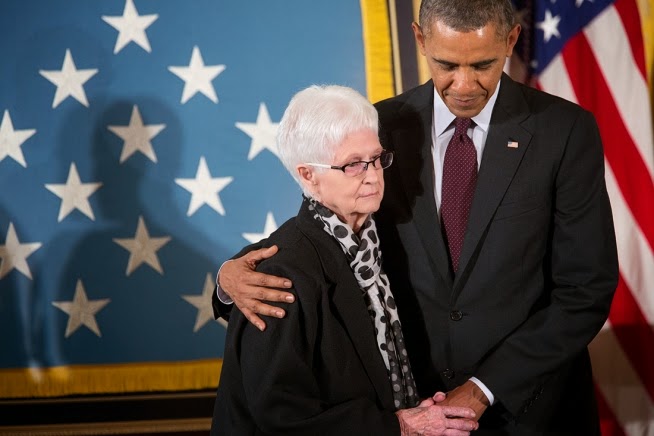 |
| President Barack Obama presents the posthumous Medal of Honor for
Sergeant Jack Weinstein during the Medal of Honor ceremony in the East
Room of the White House, March 18, 2014. The award is accepted on his
behalf by his widow Nancy Weinstein. (Official White House Photo by
Amanda Lucidon) |
MILITARY AIDE: Nancy Weinstein accepting on behalf of her husband, Sergeant Jack Weinstein.
Sergeant Jack Weinstein distinguished himself by acts of gallantry and intrepidity above and beyond the call of duty while leading 1st Platoon, Company G, 21st Infantry Regiment, 24th Infantry Division in Kumsong, Korea on October 19, 1951. That afternoon, thirty enemy troops counterattacked Sergeant Weinstein’s platoon. Most of the platoon’s members had been wounded in the previous action and withdrew under the heavy fire. Sergeant Weinstein, however, remained in his position and continued to fight off the onrushing enemy, killing at least six with his M-1 rifle before running out of ammunition. Although under extremely heavy enemy fire, Sergeant Weinstein refused to withdraw and continued fighting by throwing enemy hand grenades found lying near his position. He again halted the enemy’s progress and inflicted numerous casualties. Alone and unaided, he held the ground which his platoon had fought tenaciously to take and held out against overwhelming odds until another platoon was able to relieve him and drive back the enemy. Sergeant Weinstein’s leg had been broken by an enemy grenade and old wounds suffered in previous battles had reopened, but he refused to withdraw and successfully bought time for his wounded comrades to reach friendly lines. Sergeant Weinstein’s extraordinary heroism and selflessness above and beyond the call of duty are in keeping with the highest traditions of the military service and reflect great credit upon himself, his unit and the United States Army.
(The medal is presented.) (Applause.)
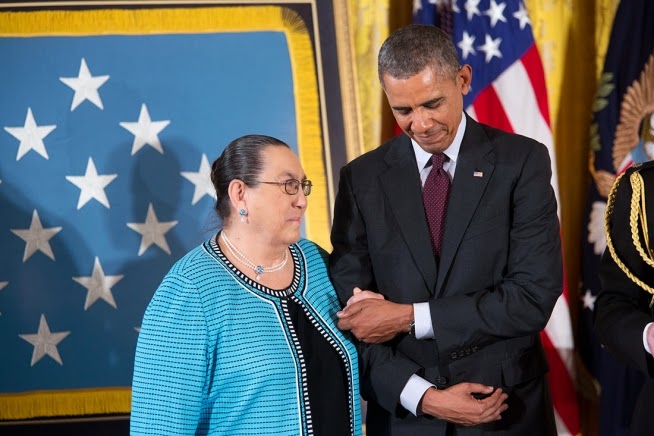 |
| President Barack Obama presents the posthumous Medal of Honor for
Private Pedro Cano during the Medal of Honor ceremony in the East Room
of the White House, March 18, 2014. The award is accepted on his behalf
by his daughter Dominga Perez. (Official White House Photo by Amanda
Lucidon) |
MILITARY AIDE: Dominga Perez accepting on behalf of her father, Private Pedro Cano.
Private Pedro Cano distinguished himself by acts of gallantry and intrepidity above and beyond the call of duty while serving with Company C, 8th Infantry Regiment, 4th Infantry Division during combat operations against an armed enemy in Schevenhutte, Germany on December 2 and 3, 1944. On the afternoon of the 2nd, American infantrymen launched an attack against German emplacements but were repulsed by enemy machinegun fire. Armed with a rocket launcher, Private Cano crawled through a densely mined area under heavy enemy fire and successfully reached a point within ten yards of the nearest emplacement. He quickly fired a rocket into the position, killing the two gunners and five supporting riflemen. Without hesitating, he fired into a second position, killing two more gunners, and proceeded to assault the position with hand grenades, killing several others and dispersing the rest. Then, when an adjacent company encountered heavy fire, Private Cano crossed his company front, crept to within fifteen yards of the nearest enemy emplacement and killed the two machinegunners with a rocket. With another round he killed two more gunners and destroyed a second gun. On the following day, his company renewed the attack and again encountered heavy machinegun fire. Private Cano, armed with his rocket launcher, again moved across fire-swept terrain and destroyed three enemy machineguns in succession, killing the six gunners. Private Cano’s extraordinary heroism and selflessness above and beyond the call of duty are in keeping with the highest traditions of military service and reflect great credit upon himself, his unit and the United States Army.
(The medal is presented.) (Applause.)
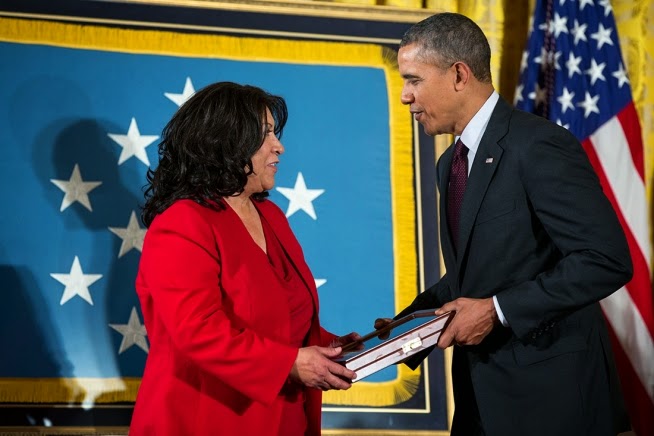 |
| President Barack Obama presents the posthumous Medal of Honor for
Private Joe Gandara during the Medal of Honor ceremony in the East Room
of the White House, March 18, 2014. The award is accepted on his behalf
by his niece Miriam Adams. (Official White House Photo by Amanda
Lucidon) |
MILITARY AIDE: Miriam Adams accepting on behalf of her uncle, Private Joe Gandara.
Private Joe Gandara distinguished himself by acts of gallantry and intrepidity above and beyond the call of duty while serving with Company D, 2d Battalion, 507th Parachute Infantry Regiment, 17th Airborne Division during combat operations against an armed enemy in Amfreville, France on June 9, 1944. On that day, Private Gandara’s detachment came under devastating enemy fire from a strong German force, pinning the men to the ground for a period of four hours. Private Gandara voluntarily advanced alone toward the enemy position. Firing his machinegun from his hip as he moved forward, he destroyed three hostile machineguns before he was fatally wounded. Private Gandara’s extraordinary heroism and selflessness at the cost of his own life, above and beyond the call of duty, are in keeping with the highest traditions of military service and reflect great credit upon himself, his unit and the United States Army.
(The medal is presented.) (Applause.)
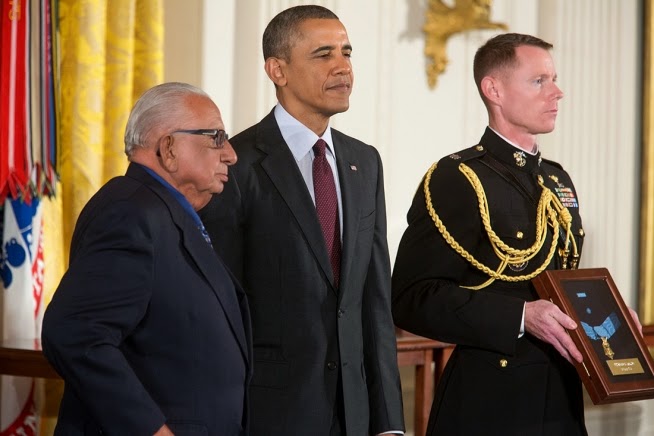 |
| President Barack Obama presents the posthumous Medal of Honor for
Private First Class Salvador J. Lara during the Medal of Honor ceremony
in the East Room of the White House, March 18, 2014. The award is
accepted on his behalf by his brother Alfonzo Lara. (Official White
House Photo by Chuck Kennedy) |
MILITARY AIDE: Alfonzo Lara accepting on behalf of his brother, Private First Class Salvador J. Lara.
Private First Class Salvador J. Lara distinguished himself by acts of gallantry and intrepidity above and beyond the call of duty while serving as the Squad Leader of a rifle squad with 2d Platoon, Company L, 180th Infantry, 45th Infantry Division during combat operations against an armed enemy in Aprilia, Italy on May 27 and 28, 1944. On the afternoon of the 27th, Private First Class Lara aggressively led his rifle squad in neutralizing multiple enemy strongpoints and in inflicting large numbers of casualties on the enemy. Having taken his initial objective, Private First Class Lara noticed that the unit to his right was meeting stiff resistance from a large, well-entrenched enemy force in a deep ditch. Private First Class Lara quickly gathered three men and attacked a wide section of the enemy position, killing four, forcing fifteen others to surrender and causing two enemy mortar crews to abandon their weapons. His fearless and efficient performance enabled both his own unit and the unit to his right to continue to their objective. The next morning, as his company resumed the attack, Private First Class Lara sustained a severe leg wound, but did not stop to receive first aid. His company suffered heavy casualties as a result of withering machinegun fire coming from an enemy strongpoint on the right flank. After requesting permission to destroy the enemy machineguns armed only with a Browning Automatic Rifle, Private First Class Lara crawled alone toward the nearest machinegun. Despite his painful wound and the extreme danger of the task, he rose and fearlessly charged the nest, killing the crew members. Another machinegun opened fire on him, but he quickly neutralized this weapon with accurate fire from his Browning, killing three more of the enemy. His aggressive attack forced two other machinegun crews to flee their weapons. After rejoining his company, Private First Class Lara continued his exemplary performance until he captured his objective. Private First Class Lara’s extraordinary heroism and selflessness above and beyond the call of duty are in keeping with the highest traditions of military service and reflect great credit upon himself, his unit and the United States Army.
(The medal is presented.) (Applause.)
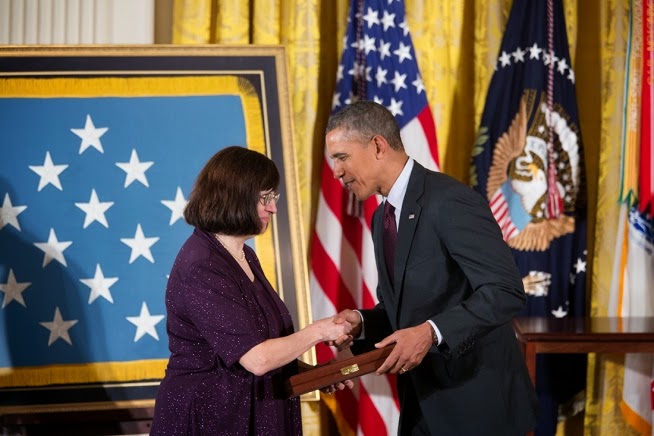 |
| President Barack Obama presents the posthumous Medal of Honor for
Private First Class William F. Leonard during the Medal of Honor
ceremony in the East Room of the White House, March 18, 2014. The award
is accepted on his behalf by his daughter Patricia Kennedy. (Official
White House Photo by Amanda Lucidon) |
MILITARY AIDE: Patricia Kennedy accepting on behalf of her father, Private First Class William F. Leonard.
Private First Class William F. Leonard distinguished himself by acts of gallantry and intrepidity above and beyond the call of duty while serving as a Squad Leader in Company C, 30th Infantry Regiment, 3d Infantry Division during combat operations against an armed enemy near St. Die, France on November 7, 1944. Private First Class Leonard’s platoon was reduced to eight men as a result of blistering artillery, mortar, machinegun, and rifle fire. Private First Class Leonard led the survivors in an assault over a hill covered by trees and shrubs which the enemy continuously swept with automatic weapons fire. Ignoring bullets which pierced his pack, Private First Class Leonard killed two snipers at ranges of fifty and seventy-five yards and engaged and destroyed a machinegun nest with grenades, killing its two-man crew. Though momentarily stunned by an exploding bazooka shell, Private First Class Leonard relentlessly advanced, ultimately knocking out a second machinegun nest and capturing the roadblock objective. Private First Class Leonard’s extraordinary heroism and selflessness above and beyond the call of duty are in keeping with the highest traditions of military service and reflect great credit upon himself, his unit and the United States Army.
(The medal is presented.) (Applause.)
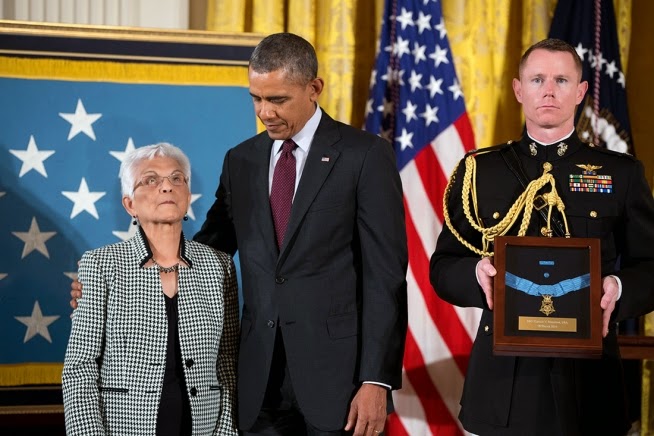 |
| President Barack Obama presents the posthumous Medal of Honor for Staff
Sergeant Manuel V. Mendoza during the Medal of Honor ceremony in the
East Room of the White House, March 18, 2014. The award is accepted on
his behalf by his widow Alice Mendoza. (Official White House Photo by
Pete Souza) |
MILITARY AIDE: Alice Mendoza accepting on behalf of her husband, Staff Sergeant Manuel V. Mendoza.
Staff Sergeant Manuel V. Mendoza distinguished himself by acts of gallantry and intrepidity above and beyond the call of duty while serving as a Platoon Sergeant with Company B, 350th Infantry, 88th Infantry Division during combat operations against an armed enemy on Mt. Battaglia, Italy on October 4, 1944. That afternoon, the enemy launched a violent counterattack preceded by a heavy mortar barrage. Staff Sergeant Mendoza, already wounded in the arm and leg, grabbed a Thompson sub-machinegun and ran to the crest of the hill where he saw approximately 200 enemy troops charging up the slopes employing flame-throwers, machine pistols, rifles, and hand grenades. Staff Sergeant Mendoza immediately began to engage the enemy, firing five clips and killing ten enemy soldiers. After exhausting his ammunition, he picked up a carbine and emptied its magazine at the enemy. By this time, an enemy soldier with a flame-thrower had almost reached the crest, but was quickly eliminated as Staff Sergeant Mendoza drew his pistol and fired. Seeing that the enemy force continued to advance, Staff Sergeant Mendoza jumped into a machinegun emplacement that had just been abandoned and opened fire. Unable to engage the entire enemy force from his location, he picked up the machinegun and moved forward, firing from his hip and spraying a withering hail of bullets into the oncoming enemy, causing them to break into confusion. He then set the machinegun on the ground and continued to fire until the gun jammed. Without hesitating, Staff Sergeant Mendoza began throwing hand grenades at the enemy, causing them to flee. After the enemy had withdrawn, he advanced down the forward slope of the hill, retrieved numerous enemy weapons scattered about the area, captured a wounded enemy soldier, and returned to consolidate friendly positions with all available men. Staff Sergeant Mendoza’s gallant stand resulted in thirty German soldiers killed and the successful defense of the hill. Staff Sergeant Mendoza’s extraordinary heroism and selflessness above and beyond the call of duty are in keeping with the highest traditions of military service and reflect great credit upon himself, his unit and the United States Army.
(The medal is presented.) (Applause.)
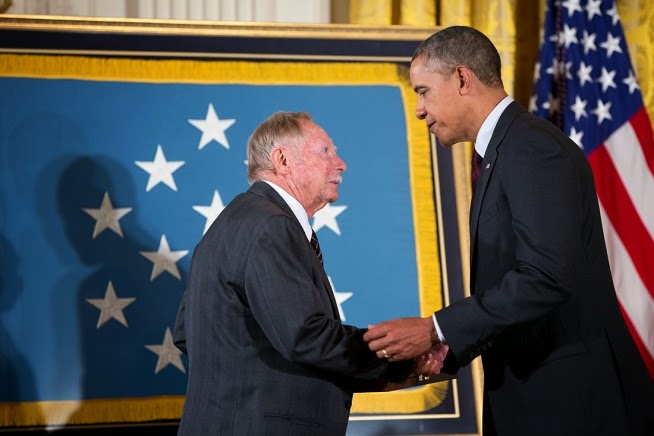 |
| President Barack Obama presents the posthumous Medal of Honor for
Sergeant Alfred B. Nietzel during the Medal of Honor ceremony in the
East Room of the White House, March 18, 2014. The award is accepted on
his behalf by his cousin Robert Nietzel. (Official White House Photo by
Pete Souza) |
MILITARY AIDE: Robert Nietzel accepting on behalf of his first cousin, Sergeant Alfred B. Nietzel.
Sergeant Alfred B. Nietzel distinguished himself by acts of gallantry and intrepidity above and beyond the call of duty while serving as a section leader for Company H, 16th Infantry Regiment, 1st Infantry Division during combat operations against an armed enemy in Heistern, Germany on November 18, 1944. That afternoon, Sergeant Nietzel fought tenaciously to repel a vicious enemy attack against his unit. Sergeant Nietzel employed accurate, intense fire from his machinegun and successfully slowed the hostile advance. However, the overwhelming enemy force continued to press forward. Realizing he desperately needed reinforcements, Sergeant Nietzel ordered the three remaining members of his squad to return to the company command post and secure aid. He immediately turned his attention to covering their movement with his fire. After expending all his machinegun ammunition, Sergeant Nietzel began firing his rifle into the attacking ranks until he was killed by the explosion of an enemy grenade. Sergeant Nietzel’s extraordinary heroism and selflessness at the cost of his own life, above and beyond the call of duty, are in keeping with the highest traditions of military service and reflect great credit upon himself, his unit and the United States Army.
(The medal is presented.) (Applause.)
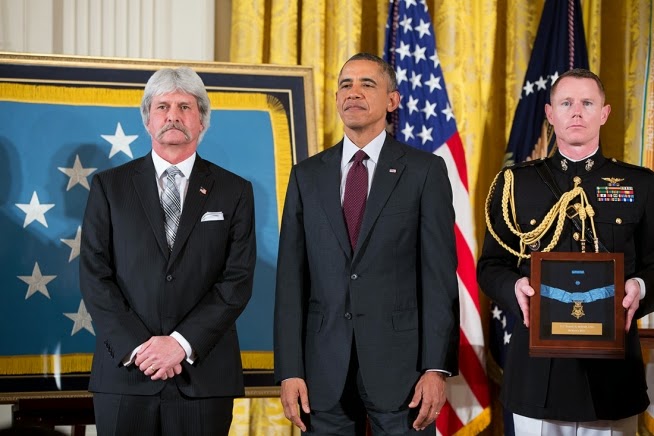 |
| President Barack Obama presents the posthumous Medal of Honor for First
Lieutenant Donald K. Schwab during the Medal of Honor ceremony in the
East Room of the White House, March 18, 2014. The award is accepted on
his behalf by his son Dr. Terry Schwab. (Official White House Photo by
Pete Souza) |
MILITARY AIDE: Dr. Terry Schwab accepting on behalf of his father, First Lieutenant Donald K. Schwab.
First Lieutenant Donald K. Schwab distinguished himself by acts of gallantry and intrepidity above and beyond the call of duty while serving as the Commander of Company E, 15th Infantry Regiment, 3d Infantry Division, during combat operations against an armed enemy near Lure, France on September 17, 1944. That afternoon, as First Lieutenant Schwab led his company across four hundred yards of exposed ground, an intense, grazing burst of machinegun and machine-pistol fire sprung forth without warning from a fringe of woods directly in front of the American force. First Lieutenant Schwab quickly extricated his men from the attempted ambush and led them back to a defiladed position. Soon after, he was ordered to overwhelm the enemy line. He rapidly organized his men into a skirmish line and, with indomitable courage, again led them forward into the lethal enemy fire. When halted a second time, First Lieutenant Schwab moved from man to man to supervise collection of the wounded and organize his company’s withdrawal. From defilade, he rallied his decimated force for a third charge on the hostile strong point and successfully worked his way to within fifty yards of the Germans before ordering his men to hit the dirt. While automatic weapons fire blazed around him, he rushed forward alone, firing his carbine at the German foxholes, aiming for the vital enemy machine-pistol nest which had sparked the German resistance and caused heavy casualties among his men. Silhouetted through the mist and rain by enemy flares, he charged to the German emplacement, ripped the half-cover off the hostile firing pit, struck the German gunner on the head with his carbine butt and dragged the German back through a hail of fire to friendly lines. First Lieutenant Schwab’s action so disorganized hostile infantry resistance that the enemy forces withdrew, abandoning their formidable defensive line. First Lieutenant Schwab’s extraordinary heroism and selflessness above and beyond the call of duty are in keeping with the highest traditions of military service and reflect great credit upon himself, his unit and the United States Army.
(The medal is presented.) (Applause.)
THE PRESIDENT: Ladies and gentlemen, it is very rare where we have the opportunity to reflect on the extraordinary courage and patriotism of such a remarkable collection of men. We are so grateful to them. We are so grateful to their families. It makes us proud and it makes us inspired. And so, before we conclude the program, I would ask all those who have witnessed this extraordinary day to please rise and give these latest recipients of the Medal of Honor your warmest applause. (Applause.)
Chaplain, would you give us the benediction?
(A prayer is offered.)
Thank you so much, everybody. This concludes our program. But please have an opportunity to enjoy the White House. We are so grateful that all of you had a chance to come. God bless you. God bless America. (Applause.)
END
4:54 P.M. EDT
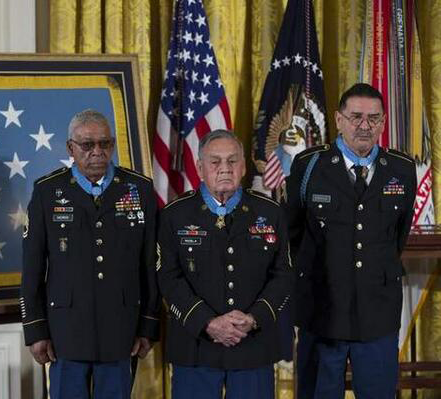 |
| Staff Sergeant Melvin Morris - Sergeant First Class Jose Rodela - Specialist Four Santiago J. Erevia |

 Congressional Medal of Honor Society
 Congressional Medal of Honor Foundation
 Home of Heroes
 U.S Army Center of Military History
 U.S. Department of Defense
 The Pritzker Military Library

 Brings to life some of the rich stories that define America’s highest honor as it seeks to answer the broader question of what the Medal of Honor says about us as a nation. Read more...

 Subscribe in a reader