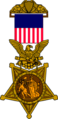
Tibor Rubin was a Hungarian-born Holocaust survivor who emigrated to the United States in 1948 and received the Medal of Honor for his valorous actions during the Korean War as a U.S. Infantry soldier and POW from President George W. Bush on September 23, 2005, 55 years later. Rubin WAS a resident of Garden Grove, California.
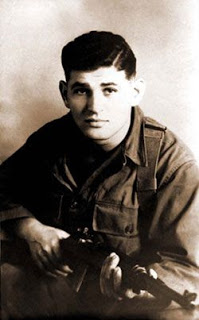 |
CORPORAL TIBOR RUBIN
photo courtesy Medal of Honor Society |
Rubin was repeatedly nominated for various military decorations, but was overlooked because of antisemitism by a superior. Fellow soldiers who filed affidavits supporting Rubin's nomination for the Medal of Honor said that Rubin's sergeant "was an anti-Semite who gave Rubin dangerous assignments in hopes of getting him killed".
Rubin was born in Pásztó, a Hungarian town with a Jewish population of 120 families, the son of a shoemaker and one of six children. At age 13, he was transported to the Mauthausen concentration camp in Austria and liberated two years later by American combat troops. Both his parents and his two sisters perished in the Holocaust.
Rubin came to the United States in 1948, settled in New York and worked first as a shoemaker. He then apprenticed as a butcher at Michael Bela Wilhelm's Hungarian butcher shop on Third Avenue in the Yorkville neighborhood for about a year.
In 1949, he tried to enlist in the U.S. Army. He failed the English language test, but tried again in 1950 and passed with some judicious help from two fellow test-takers.
By July 1950, Private First Class Rubin found himself fighting in South Korea with I Company, Eighth Cavalry Regiment, First Cavalry Division. According to lengthy affidavits submitted by nearly a dozen men who served with Rubin in South and North Korea, mostly self-described "country boys" from the South and Midwest, an antisemitic army sergeant named Arthur Peyton consistently "volunteered" Rubin for the most dangerous patrols and missions.
During one mission, according to the testimonies of his comrades, Rubin secured a needed route of retreat for his rifle company by single-handedly defending a hill for 24 hours against waves of North Korean soldiers. For this and other acts of bravery, Rubin was recommended four times for the Medal of Honor by two of his commanding officers. Both of these officers were killed in action shortly afterwards, but not before ordering Rubin's sergeant to begin the necessary paperwork recommending Rubin for the Medal of Honor. Some of Rubin’s fellow GIs were present and witnessed when the order was issued to the sergeant, and all are convinced that the sergeant deliberately ignored the orders. "I really believe, in my heart, that [the sergeant] would have jeopardized his own safety rather than assist in any way whatsoever in the awarding of the Medal of Honor to a person of Jewish descent", wrote Corporal Harold Speakman in a notarized affidavit.
Toward the end of October 1950, massive Chinese troop concentrations had crossed the border into North Korea and were attacking the unprepared American troops now trapped way inside North Korea. Most of Rubin's regiment had been killed or captured. Rubin, severely wounded, was captured and spent the next 30 months in a prisoner of war camp.
Faced with constant hunger, filth, and disease, most of the GIs simply gave up. "No one wanted to help anyone. Everybody was for himself", wrote Leo A. Cormier Jr., a former sergeant and POW. The exception was Rubin. Almost every evening, Rubin would sneak out of the prison camp to steal food from the Chinese and North Korean supply depots, knowing that he would be shot if caught. "He shared the food evenly among the GIs," Cormier wrote. He also took care of us, nursed us, carried us to the latrine..., he did many good deeds, which he told us were mitzvahs in the Jewish tradition... he was a very religious Jew and helping his fellow men was the most important thing to him". The survivors of the prison war camp credited Rubin with keeping them alive and saving at least 40 American soldiers.
Rubin refused his captors' repeated offers of repatriation to Hungary, by then behind the Iron Curtain.
In 1993, a study was commissioned by the United States Army to investigate racial discrimination in the awarding of medals. In 2001, after considering the case of Leonard M. Kravitz, Congress directed the military to further review certain cases. The ensuing investigation showed that Rubin had been the subject of discrimination due to his religion and should have received the Medal of Honor.
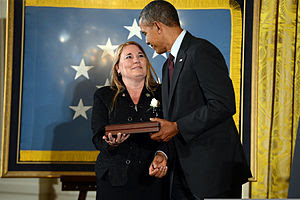
In 2005, President George W. Bush presented the Medal of Honor to Rubin in a ceremony at the White House, for his actions in 1950 during the Korean War.
Source: Wikipedia
Medal of Honor Citation Corporal Tibor Rubin
Corporal Tibor Rubin distinguished himself by extraordinary heroism during the period from July 23, 1950, to April 20, 1953, while serving as a rifleman with Company I, 8th Cavalry Regiment, 1st Cavalry Division in the Republic of Korea. While his unit was retreating to the Pusan Perimeter, Corporal Rubin was assigned to stay behind to keep open the vital Taegu-Pusan Road link used by his withdrawing unit. During the ensuing battle, overwhelming numbers of North Korean troops assaulted a hill defended solely by Corporal Rubin. He inflicted a staggering number of casualties on the attacking force during his personal 24-hour battle, single-handedly slowing the enemy advance and allowing the 8th Cavalry Regiment to complete its withdrawal successfully. Following the breakout from the Pusan Perimeter, the 8th Cavalry Regiment proceeded northward and advanced into North Korea. During the advance, he helped capture several hundred North Korean soldiers. On October 30, 1950, Chinese forces attacked his unit at Unsan, North Korea, during a massive nighttime assault. That night and throughout the next day, he manned a .30 caliber machine gun at the south end of the unit's line after three previous gunners became casualties. He continued to man his machine gun until his ammunition was exhausted. His determined stand slowed the pace of the enemy advance in his sector, permitting the remnants of his unit to retreat southward. As the battle raged, Corporal Rubin was severely wounded and captured by the Chinese. Choosing to remain in the prison camp despite offers from the Chinese to return him to his native Hungary, Corporal Rubin disregarded his own personal safety and immediately began sneaking out of the camp at night in search of food for his comrades. Breaking into enemy food storehouses and gardens, he risked certain torture or death if caught. Corporal Rubin provided not only food to the starving Soldiers, but also desperately needed medical care and moral support for the sick and wounded of the POW camp. His brave, selfless efforts were directly attributed to saving the lives of as many as forty of his fellow prisoners. Corporal Rubin's gallant actions in close contact with the enemy and unyielding courage and bravery while a prisoner of war are in the highest traditions of military service and reflect great credit upon himself and the United States Army.


 Congressional Medal of Honor Society
 Congressional Medal of Honor Foundation
 Home of Heroes
 U.S Army Center of Military History
 U.S. Department of Defense
 The Pritzker Military Library

 Brings to life some of the rich stories that define America’s highest honor as it seeks to answer the broader question of what the Medal of Honor says about us as a nation. Read more...

 Subscribe in a reader