Friday, December 27, 2024

Medal of Honor Recipient, Korean War Veteran Rudy Hernandez Dies


WASHINGTON, Dec. 23, 2013 - An Army veteran who earned the Medal of Honor for heroic actions while stationed with G Company, 187th Airborne Regimental Combat Team near Wontong-ne, North Korea, May 31, 1951, died Dec. 21 in Fayetteville, N.C.

The son of a migrant working family in rural California, U.S. Army Cpl. Rodolfo “Rudy” Hernandez enlisted at age 17 and was stationed in Germany before being sent into battle, where 54,200 American Soldiers perished in the Korean War.
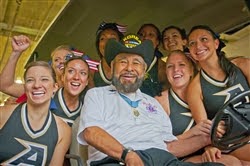
Medal of Honor recipient Rodolfo P. Hernandez
poses with members of the U.S. Military Academy
Rabble Rousers before taking part in the coin
toss Sept. 29, 2013, at Cotton Bowl Stadium in
Dallas. Hernandez died Dec. 21 in Fayetteville,
N.C. U.S. Army photo by Sgt. Ken Scar 
Hernandez and his platoon were among the first to be sent to battle on Hill 420.

His 11th and final airborne operation involved Hernandez jumping from just 600 feet above ground, into the enemy’s lair behind the North Korean capital.

“We jumped into the enemy ... Before the jump I felt like John Wayne,” Hernandez reported in a 2004 interview to The Point, a U.S. Army newspaper in Germany.

“By the time my chute opened, I was already on the ground,” Hernandez said. “The first round that went over my head was artillery. Afterward I felt this big,” he said, holding his fingers about an inch apart. “I knew they meant business.”

But hope seemed to diminish along with the beleaguered platoon’s ammunition, as enemy fire -- mortars, heavy artillery and machine gun bullets -- rained on the soldiers, causing multiple casualties.

According to Hernandez’ Medal of Honor citation, he and his comrades were forced to withdraw, but, wounded in an exchange of grenades, he continued to deliver deadly fire into the ranks of his onrushing assailants until a ruptured cartridge rendered his rifle inoperative.

With a head wound and a jammed rifle, Hernandez scrambled to put his bayonet in his rifle and bounded toward the enemy. His charge stymied their advance and enabled his platoon to regain the lost ground.

Hernandez killed six enemy troops before losing consciousness after a grenade exploded near his head and blew off part of his skull. Thirty days later, he would awaken in a military hospital temporarily unable to speak or use his arms and legs.

In a White House ceremony, President Harry S Truman presented Hernandez the highest military decoration for combat heroism on April 12, 1952.

Hernandez spent his post-war years working for Department of Veterans Affairs, retiring in 1980. He is survived by his wife and three children from a previous marriage.

Department of Defense

By Amaani Lyle
American Forces Press Service

Editor's Note:  Today there are 77 Living Recipients of the  Medal of Honor. 8 from World War II, 10 from the Korean War, 53 from the Vietnam War and 6 from the War in Afghanistan.
Sunday, December 22, 2024

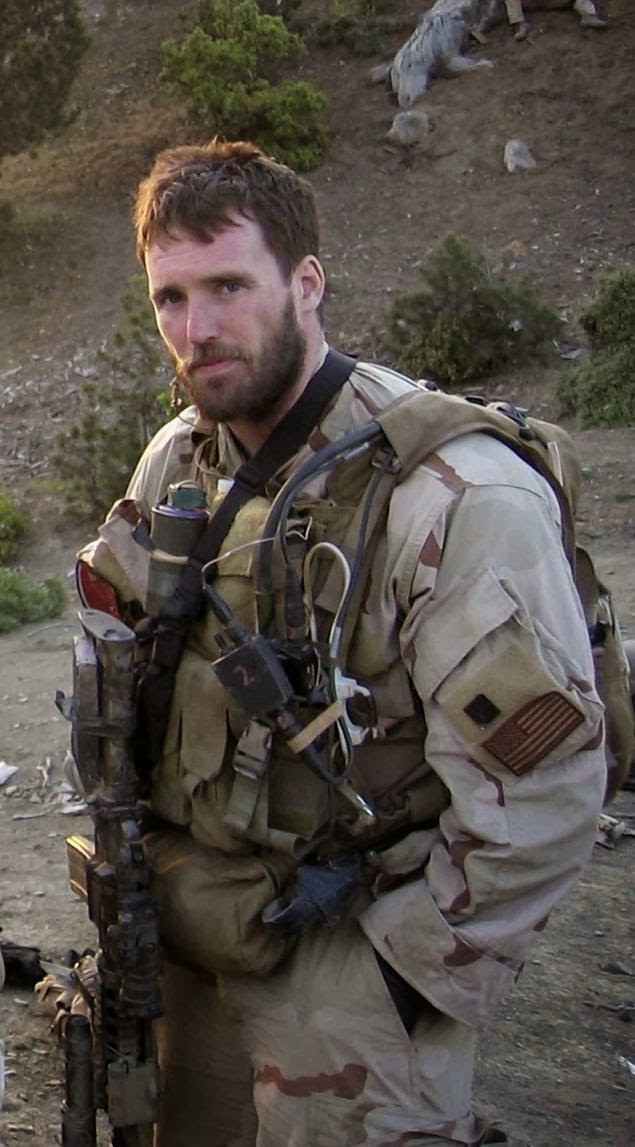
Universal Pictures 'Lone Survivor' film portrays Medal of Honor recipient Lt. Michael Murphy


Actor Taylor Kitsch couldn’t sleep for days as he waited for the most important critical review of his career.

Murphy was killed while leading
a reconnaissance mission
in Afghanistan.
Cast to portray real-life Medal of Honor recipient Lt. Michael Murphy in the new movie “Lone Survivor,” opening Christmas Day, Kitsch braced to hear from the father of the fallen national hero from Patchogue, L.I., after watching a screening of the war drama.

It gnawed on the former “Friday Night Lights” star how Daniel Murphy would handle seeing a reenactment of his son being shot dead by Taliban insurgents as he sacrificed himself to radio in air support in an attempt to save his outnumbered men.

“I knew Daniel was seeing it, so when he wrote me an incredible email the next day, it was more of just a ‘Phew,’ ” the 32-year-old actor told the Daily News, visibly relaxing. “I laugh with him now about it . . . but honestly, I don’t know how I would’ve handled it if he and the family weren’t happy with it.”

“He doesn’t look like Mike, but he captured the essence of my son, his facial expressions, his mannerisms, his sense of humor,” said Michael’s mother, Maureen.

Her son was posthumously awarded the military’s highest honor. A memorial park in Ronkonkoma, L.I., and a post office in Patchogue now bear his name, and the naval destroyer Michael Murphy patrols the Pacific. But this movie has the potential to be a tribute of a whole other scale — spreading the story of his selfless final act to a much wider audience.

“When you hear they’re thinking about sending troops somewhere we need to understand what the real price we have to pay is,” said director Peter Berg. “We as citizens need to understand who guys like Mike Murphy were.”

That’s one of the reasons why Murphy’s best friend and fellow SEAL Marcus Luttrell, played in the movie by Mark Wahlberg, wrote the book on which “Lone Survivor” is based.

NY DAILY NEWS December 22, 2024

Saturday, December 14, 2024

Exploits of World War II Medal of Honor recipient recalled


HENRY E. ERWIN, B-29 SUPER-FORTRESS  RADIO OPERATOR’S HEROISM SAVED AIRCRAFT AND CREW MEMBERS


Air guardsman receives prestigious Henry e. Erwin Award
Story by Staff Sgt. Lealan Buehrer 182ND AIRLIFT WING

Peoria air guardsman receives prestigious Red Erwin Award
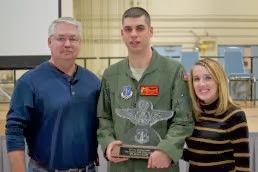
U.S. Air Force Senior Airman Ryan J. Lane of the 169th Airlift Squadron, center, displays the Red Erwin award with family members at the 182nd Airlift Wing, Peoria, Ill., Dec. 8, 2013. Lane competed against 3,000 other Air National Guard candidates to win the Staff Sgt. Henry E. "Red" Erwin Outstanding Enlisted Aircrew Member Airman of the Year Award. He was presented the honor for his outstanding accomplishments, leadership traits that impacted his unit's mission and self-improvement in areas such as education and training. (U.S. Air National Guard photo by Staff Sgt. Lealan C. Buehrer/Released) DEPARTMENT OF DEFENSE


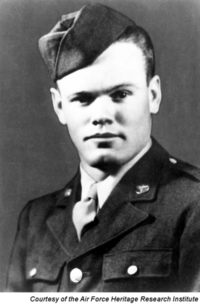
HENRY E.  ERWIN

JUNE 6, 2025   MEDAL OF HONOR Citation

Henry Erwin
He was the radio operator of a B-29 airplane leading a group formation to attack Koriyama, Japan. He was charged with the additional duty of dropping phosphoresce smoke bombs to aid in assembling the group when the launching point was reached. Upon entering the assembly area, aircraft fire and enemy fighter opposition was encountered. Among the phosphoresce bombs launched by S/Sgt. Erwin, 1 proved faulty, exploding in the launching chute, and shot back into the interior of the aircraft, striking him in the face. The burning phosphoresce obliterated his nose and completely blinded him. Smoke filled the plane, obscuring the vision of the pilot. S/Sgt. Erwin realized that the aircraft and crew would be lost if the burning bomb remained in the plane. Without regard for his own safety, he picked it up and feeling his way, instinctively, crawled around the gun turret and headed for the copilot's window. He found the navigator's table obstructing his passage. Grasping the burning bomb between his forearm and body, he unleashed the spring lock and raised the table. Struggling through the narrow passage he stumbled forward into the smoke-filled pilot's compartment. Groping with his burning hands, he located the window and threw the bomb out. Completely aflame, he fell back upon the floor. The smoke cleared, the pilot, at 300 feet, pulled the plane out of its dive. S/Sgt. Erwin's gallantry and heroism above and beyond the call of duty saved the lives of his comrades.

Erwin survived his burns. He was flown back to the United States, and after 30 months and 41 surgeries, his eyesight was restored and he regained use of one arm. 

Erwin died at the age of 80 in 2002.


ShareThis