The Medal of Honor is the highest military decoration awarded by the United States government.
It is bestowed by the United States Congress on members of the United States Armed Forces who distinguish themselves through "conspicuous gallantry and intrepidity at the risk of his or her life above and beyond the call of duty while engaged in an action against an enemy of the United States." Read more
Medal of Honor Fact Sheet
Medal of Honor Statistics
Types of Medals
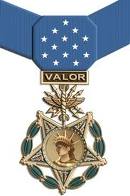
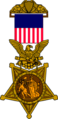
The Medal of Honor has evolved in appearance since its creation in 1862. The present Army medal consists of a gold star surrounded by a wreath, topped by an eagle on a bar inscribed with the word "Valor." The medal is attached by a hook to a light blue moiré silk neckband. There is a version of the medal for each sub-cabinet component of the Department of Defense: the Department of the Army, Department of the Navy, and Department of the Air Force. Read more
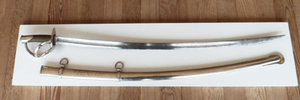
A sword belonging to Frank Baldwin,
the recipient
of two Medals of Honor, is the newest artifact at
Fort Larned National Historic Site.
The Tiffany-made sword was worn by Baldwin,
who served at Fort Larned during the 1870s.
Frank Dwight Baldwin was a career Army officer who spent time at nearly all the frontier forts in Kansas.
He
was a soldier who fought Native Americans but also understood their
plight and hardship. Baldwin also is one of only 19 men who have
received two Medals of Honor, the nation’s highest military decoration.
Frank Dwight Baldwin
On Saturday, nearly 141 years after he served at Fort Larned, the sword
Baldwin wore was presented to Fort Larned National Historic Site by the
fort’s Old Guard, a volunteer and support group that provides funding
for special projects and promotes the fort’s history.
“The opportunity to get something like this is a once-in-a lifetime
opportunity,” said Leo Oliva, a Kansas historian and writer from
Woodston.
Baldwin was stationed at Fort Larned - where the sword
will be on permanent display - from May 1 through June 5, 1872, and
again from Oct. 29, 1872, to May 1873.
Read more here: http://www.kansas.com/2013/04/27/2780437/fort-larned-presented-with-medal.html#storylink=cpy
Read more: Fort Larned presented with Medal of Honor winner’s sword
Read more here: http://www.kansas.com/2013/04/27/2780437/fort-larned-presented-with-medal.html#storylink=cpy
Read more here: http://www.kansas.com/2013/04/27/2780437/fort-larned-presented-with-medal.html#storylink=cpy
Hershel Williams arrived at Tulsa International Airport
and was welcomed by a group of Patriot Guard Riders.
TULSA, Oklahoma -The last living Medal of Honor recipient from the battle of Iwo Jima was in Tulsa Thursday evening.
Hershel Williams arrived at Tulsa International Airport and was
welcomed by a group of Patriot Guard Riders. He's went for the 11th
annual Medal of Honor Day Ceremony this weekend.
During the war, Williams was covered by only four riflemen, when he
went forward alone. He fought for four solid hours under heavy fire to
take out enemy machine gunners with his flamethrower.
The 89-year-old from West Virginia is humbled by the attention and
said the medal really belongs to other Marines who died that day.
"On the day that I did the actions that resulted in the medal, never
having heard of it before, we lost those two. They gave their lives
protecting mine," Williams said.
A reception was set 6 p.m. Thursday at the VFW Post on East 6th in Tulsa.
NewsOn6.com - Tulsa, OK - News, Weather, Video and Sports - KOTV.com |
Indiana's only living Congressional Medal of Honor recipient will have a special exhibit at the Indiana War Memorial museum.
The exhibit opens next month and will honor the life
of Sammy Davis, who received the Medal of Honor in 1967. Brigadier
General Stewart Goodwin with the Indiana War Memorials Commission says
Davis and his wife chose the Indiana War Memorial museum to display some
of his artifacts.
Goodwin says this will be the largest exhibit
in the museum. He says the dedication ceremony next month will be a
great way to say thank you to an American hero.
Source: Medal of Honor Recipient to Receive Exhibit at Indiana War Memorial
Retired Army Lt. General Robert Foley Source: Paul W. Gillespie
On
Monday, April 22, 2013, Medal of Honor recipient and Army Capt. Robert Foley encouraged students and teachers at Meade High School (Fort Meade, MD) to
pursue lives of courage and integrity.
Foley was awarded the Medal of Honor for his actions on Nov. 5, 1966, to rescue the trapped company.
It’s the nation’s highest
award for valor.
“When you go to school
every morning and go into your classrooms, what kind of climate is that?
It’s the climate you make,” he said. “There’s no limit on the amount of
excellence we can have.”
Foley retired as a
lieutenant general and lives in Alexandria, Va. He was invited to speak
as part of the school’s homeland security program.
Students in the program
learn about cyber security and defense contracting in hopes those skills
will translate to jobs in the Fort George G. Meade area.
Read more: Medal of Honor recipient tells Meade students: 'It's the climate you make'
WASHINGTON (Army News Service, April 17, 2025) -- Lt. Col. Don C. Faith
Jr., a World War II and Korean War veteran and Medal of Honor recipient,
was buried in Arlington National Cemetery, Va., on April 17, 2025.
Faith, who commanded 1st Battalion, 32nd Infantry Regiment, 7th Infantry Division, was killed Dec. 2, 1950, by communist forces.
But it would take decades and a lot of help from other Soldiers and
Defense civilians before his remains were finally recovered in North
Korea and identified. Only then could his family finally have the
closure they so desperately wanted.
Some of the fiercest fighting of the war took place in the vicinity of a
place called Chosin Reservoir in North Korea in November and December
1950. That's where Faith and his battalion were when the Chinese decided
to enter the war. The Chinese sent thousands of troops south across the
Yalu River into Korea.
The entry of China into the war and their drive south into Korea
surprised the Americans who were quickly outnumbered and outgunned.
Lt. Col. Don C. Faith
Jr
"Although physically exhausted in the bitter cold, (he) organized and
launched an attack which was soon stopped by enemy fire," the citation
reads. "He ran forward under enemy small-arms and automatic weapons
fire, got his men on their feet and personally led the fire attack as it
blasted its way through the enemy ring.
"As they came to a hairpin curve, enemy fire from a roadblock again
pinned the column down. Lt. Col. Faith organized a group of men and
directed their attack on the enemy positions on the right flank. He then
placed himself at the head of another group of men and in the face of
direct enemy fire led an attack on the enemy roadblock, firing his
pistol and throwing grenades.
"When he had reached a position approximately 30 yards from the
roadblock, he was mortally wounded, but continued to direct the attack
until the roadblock was overrun.
"Throughout the five days of action Lt. Col. Faith gave no thought to
his safety and did not spare himself. His presence each time in the
position of greatest danger was an inspiration to his men. Also, the
damage he personally inflicted firing from his position at the head of
his men was of material assistance on several occasions. ..."
Faith's Medal of Honor citation describes the action he took during this
attack, noting that he "personally led counterattacks to restore (the
battalion's) position" and link up with other units, as they'd been
disbursed by the enemy's "fanatical attack."
Read more on the Army.mil website: After 62 years, Korean War Medal of Honor recipient rests in American soil
Some students at the Episcopal School of Knoxville, TN got a visit today
from a well-known guest — retired Army Col. Walter “Joe” Marm, recipient
of the Medal of Honor.
Marm, 71, received the medal for his actions during the Battle of Ia
Drang in November 1965 when he was shot in the jaw while trying to
relieve U.S. troops pinned down by North Vietnamese forces. The battle
was portrayed in the movie, “We Were Soldiers.”
Marm told students from the fifth through eighth grades he still wonders why he lived through the fight.
“I thank God,” he said. “If the bullet had been an inch or two lower,
it would have hit my jugular (vein) and killed me. God has a plan for
you, just like he did for me.”
Marm visited the school to help promote next year’s Medal of Honor
Society convention, which will meet in Knoxville in October 2014.
Read more at Knoxnews.com Medal of Honor recipient speaks to Episcopal students
THE PRESIDENT: Good afternoon, everybody. Please have a seat. On behalf of Michelle and myself, welcome to the White House. Thank you, Chaplain.
This year, we mark the 60th anniversary of the end of the Korean War -- a time when thousands of our prisoners of war finally came home after years of starvation and hardship and, in some cases, torture. And among the homecomings, one stood out.
A group of our POWs emerged carrying a large wooden crucifix, nearly four feet tall. They had spent months on it, secretly collecting firewood, carving it -- the cross and the body -- using radio wire for a crown of thorns. It was a tribute to their friend, their chaplain, their fellow prisoner who had touched their souls and saved their lives -- Father Emil Kapaun.
This is an amazing story. Father Kapaun has been called a shepherd in combat boots. His fellow soldiers who felt his grace and his mercy called him a saint, a blessing from God. Today, we bestow another title on him -- recipient of our nation’s highest military decoration, the Medal of Honor. After more than six decades of working to make this Medal a reality, I know one of Father Kapaun’s comrades spoke for a lot of folks here when he said, “it’s about time.”
Father, as they called him, was just 35 years old when he died in that hellish prison camp. His parents and his only sibling, his brother, are no longer with us. But we are extremely proud to welcome members of the Kapaun family -- his nephews, his niece, their children -- two of whom currently serve in this country's National Guard. And we are very proud of them.
We're also joined by members of the Kansas congressional delegation, leaders from across our armed forces, and representatives from the Catholic Church, which recognizes Father Kapaun as a “Servant of God.” And we are truly humbled to be joined by men who served alongside him -- veterans and former POWs from the Korean War. (Applause.)
Now, I obviously never met Father Kapaun. But I have a sense of the man he was, because in his story I see reflections of my own grandparents and their values, the people who helped to raise me. Emil and my grandfather were both born in Kansas about the same time, both were raised in small towns outside of Wichita. They were part of that Greatest Generation -- surviving the Depression, joining the Army, serving in World War II. And they embodied those heartland values of honesty and hard work, decency and humility -- quiet heroes determined to do their part.
For Father Kapaun, this meant becoming an Army chaplain -- serving God and country. After the Communist invasion of South Korea, he was among the first American troops that hit the beaches and pushed their way north through hard mountains and bitter cold. In his understated Midwestern way, he wrote home, saying, “this outdoor life is quite the thing” -- (laughter) -- and “I prefer to live in a house once in a while.” But he had hope, saying, “It looks like the war will end soon.”
That’s when Chinese forces entered the war with a massive surprise attack -- perhaps 20,000 soldiers pouring down on a few thousand Americans. In the chaos, dodging bullets and explosions, Father Kapaun raced between foxholes, out past the front lines and into no-man’s land -- dragging the wounded to safety.
When his commanders ordered an evacuation, he chose to stay -- gathering the injured, tending to their wounds. When the enemy broke through and the combat was hand-to-hand, he carried on -- comforting the injured and the dying, offering some measure of peace as they left this Earth.
When enemy forces bore down, it seemed like the end -- that these wounded Americans, more than a dozen of them, would be gunned down. But Father Kapaun spotted a wounded Chinese officer. He pleaded with this Chinese officer and convinced him to call out to his fellow Chinese. The shooting stopped and they negotiated a safe surrender, saving those American lives.
Then, as Father Kapaun was being led away, he saw another American -- wounded, unable to walk, laying in a ditch, defenseless. An enemy soldier was standing over him, rifle aimed at his head, ready to shoot. And Father Kapaun marched over and pushed the enemy soldier aside. And then as the soldier watched, stunned, Father Kapaun carried that wounded American away.
This is the valor we honor today -- an American soldier who didn’t fire a gun, but who wielded the mightiest weapon of all, a love for his brothers so pure that he was willing to die so that they might live. And yet, the incredible story of Father Kapaun does not end there.
He carried that injured American, for miles, as their captors forced them on a death march. When Father Kapaun grew tired, he’d help the wounded soldier hop on one leg. When other prisoners stumbled, he picked them up. When they wanted to quit -- knowing that stragglers would be shot -- he begged them to keep walking.
In the camps that winter, deep in a valley, men could freeze to death in their sleep. Father Kapaun offered them his own clothes. They starved on tiny rations of millet and corn and birdseed. He somehow snuck past the guards, foraged in nearby fields, and returned with rice and potatoes. In desperation, some men hoarded food. He convinced them to share. Their bodies were ravaged by dysentery. He grabbed some rocks, pounded metal into pots and boiled clean water. They lived in filth. He washed their clothes and he cleansed their wounds.
The guards ridiculed his devotion to his Savior and the Almighty. They took his clothes and made him stand in the freezing cold for hours. Yet, he never lost his faith. If anything, it only grew stronger. At night, he slipped into huts to lead prisoners in prayer, saying the Rosary, administering the sacraments, offering three simple words: “God bless you.” One of them later said that with his very presence he could just for a moment turn a mud hut into a cathedral.
That spring, he went further -- he held an Easter service. I just met with the Kapaun family. They showed me something extraordinary -- the actual stole, the purple vestment that Father Kapaun wore when he celebrated Mass inside that prison camp.
As the sun rose that Easter Sunday, he put on that purple stole and led dozens of prisoners to the ruins of an old church in the camp. And he read from a prayer missal that they had kept hidden. He held up a small crucifix that he had made from sticks. And as the guards watched, Father Kapaun and all those prisoners -- men of different faith, perhaps some men of no faith -- sang the Lord’s Prayer and “America the Beautiful.” They sang so loud that other prisoners across the camp not only heard them, they joined in, too -- filling that valley with song and with prayer.
That faith -- that they might be delivered from evil, that they could make it home -- was perhaps the greatest gift to those men; that even amidst such hardship and despair, there could be hope; amid their misery in the temporal they could see those truths that are eternal; that even in such hell, there could be a touch of the divine. Looking back, one of them said that that is what “kept a lot of us alive.”
Yet, for Father Kapaun, the horrific conditions took their toll. Thin, frail, he began to limp, with a blood clot in his leg. And then came dysentery, then pneumonia. That’s when the guards saw their chance to finally rid themselves of this priest and the hope he inspired. They came for him. And over the protests and tears of the men who loved him, the guards sent him to a death house -- a hellhole with no food or water -- to be left to die.
And yet, even then, his faith held firm. “I’m going to where I’ve always wanted to go,” he told his brothers. “And when I get up there, I’ll say a prayer for all of you.” And then, as was taken away, he did something remarkable -- he blessed the guards. “Forgive them,” he said, “for they know not what they do.” Two days later, in that house of death, Father Kapaun breathed his last breath. His body was taken away, his grave unmarked, his remains unrecovered to this day.
The war and the awful captivity would drag on for another two years, but these men held on -- steeled by the memory and moral example of the man they called Father. And on their first day of freedom, in his honor, they carried that beautiful wooden crucifix with them.
Some of these men are here today -- including Herb Miller, the soldier that Father Kapaun saved in that ditch and then carried all those miles. Many are now in their 80s, but make no mistake, they are among the strongest men that America has ever produced. And I would ask all of our courageous POWs from the Korean War to stand if they're able and accept the gratitude of a grateful nation. (Applause.)
I’m told that in their darkest hours in the camp in that valley, these men turned to a Psalm. As we prepare for the presentation of the Medal of Honor to Father Kapaun’s nephew, Ray, I want to leave you with the words of that Psalm, which sustained these men all those years ago.
Even though I walk in the valley of the shadow of death,
I will fear no evil, for you are with me;
Your rod and your staff, they comfort me.
You prepare a table for me in the presence of my enemies.
You anoint my head with oil; my cup overflows.
Surely, your goodness and love will follow me all the days of my life.
And I will dwell in the house of the Lord forever.
Ray, would you please join me on stage for the reading of the citation?
MILITARY AIDE: The President of the United States of America, authorized by Act of Congress, March 3, 1863, has awarded in the name of Congress the Medal of Honor to Chaplain Emil J. Kapaun, United States Army, for conspicuous gallantry and intrepidity at the risk of his life above and beyond the all of duty.
Chaplain Emil J. Kapaun distinguished himself by acts of gallantry and intrepidity above and beyond the call of duty while serving with the 3rd Battalion, 8th Cavalry Regiment, 1st Calvary Division during combat operations against an armed enemy at Unsan, Korea, from November 1st to 2nd, 1950.
On November 1st, as Chinese Communist Forces viciously attacked friendly elements, Chaplain Kapaun calmly walked through withering enemy fire in order to provide comfort and medical aid to his comrades and rescue friendly wounded from no-man’s land.
Though the Americans successfully repelled the assault, they found themselves surrounded by the enemy. Facing annihilation, the able-bodied men were ordered to evacuate. However, Chaplain Kapaun, fully aware of his certain capture, elected to stay behind with the wounded.
After the enemy succeeded in breaking through the defense in the early morning hours of November 2nd, Chaplain Kapaun continually made rounds as hand-to-hand combat ensued. As Chinese Communist Forces approached the American position, Chaplain Kapaun noticed an injured Chinese officer amongst the wounded and convinced him to negotiate the safe surrender of the American forces.
Shortly after his capture, Chaplain Kapaun, with complete disregard for his personal safety and unwavering resolve, bravely pushed aside an enemy soldier preparing to execute Sergeant First Class Herbert A. Miller. Not only did Chaplain Kapaun’s gallantry save the life of Sergeant Miller, but also his unparalleled courage and leadership inspired all those present, including those who might have otherwise fled in panic to remain and fight the enemy until captured.
Chaplain Kapaun’s extraordinary heroism and selflessness above and beyond the call of duty are in keeping with the highest traditions of military service and reflect great credit upon himself, the 3rd Battalion, 8th Cavalry Regiment, the 1st Calvary Division and the United States Army.
(The Medal of Honor is presented.) (Applause.)
CHAPLAIN RUTHERFORD: And let us pray together:
Lord, God, let us go forth into the world in peace and dedication to your service. Let us follow Chaplain Kapaun’s example and hold fast to that which is good; render to no person evil for evil; strengthen the faint-hearted. May we support the weary, encourage the tired, and honor all peoples. Let us love and serve, and may God’s blessing be upon us, pray with us today and always, as we ask and pray in your Holy Name. Amen.
THE PRESIDENT: Well, I can't imagine a better example for all of us -- whether in uniform or not in uniform, a better example to follow. Father Kapaun’s life I think is a testimony to the human spirit, the power of faith, and reminds us of the good that we can do each and every day regardless of the most difficult of circumstances. We can always be an instrument of his will.
So I hope all of you have enjoyed this ceremony. I certainly have been extremely touched by it. To the Kapaun family, God bless you. To all our veterans, we’re so proud of you.
And my understanding is that the White House has pretty decent food -- (laughter) -- so I hope all of you enjoy the reception. Thank you very much. (Applause.)
END
2:42 P.M. EDT
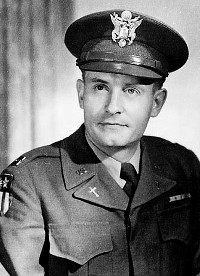
Photo credit: President Barack Obama holds Chaplain (Captain) Emil Kapaun's Easter stole in the Oval Office during a greet with Kapaun's family in the Oval Office, April 11, 2013. The President and First Lady Michelle Obama met with members of Chaplain Kapaun's family before awarding him the Medal of Honor posthumously during a ceremony in the East Room. (Official White House Photo by Pete Souza)
President Obama will present the Medal of Honor to family members of U.S. Army Chaplain (Capt.) Kapaun in a White House ceremony on Thursday, Apr. 11th 2013 at 2:10 p.m. EDT in recognition of his valor during major combat operations against an armed enemy at Unsan, Korea and as a prisoner of war from November 1-2, 1950.
Kapaun began his military chaplaincy at Camp Wheeler, Georgia, in October 1944. He was sent to India and served in the Burma Theater and was promoted to Captain in January 1946.. He returned stateside in May 1946. Kapaun was discharged in 1946 and went to the Catholic University of Washington where in 1948 he earned an M.A. in education.
In September 1948, he re-joined the Army and resumed his chaplaincy at Fort Bliss, El Paso, Texas.
In January 1950 he was stationed near Mt. Fuji, Japan as a military chaplain until alerted into combat in July 1950. In that month, Kapaun was ordered to Korea from Japan, a month after North Korea invaded South Korea. Kapaun's unit, the 8th Cavalry Regiment, 1st Cavalry Division, from Ft. Bliss landed in South Korea and participated in the fighting on the Pusan perimeter. From there, he was constantly on the move northward until his capture by Chinese Communists in November 1950.
Fr. Kapaun next to his pup
tent somewhere in Korea, Aug 1950.
Read more here: http://www.kansas.com/2009/12/03/1082680/father-kapauns-military-career.html#storylink=cpy
His main complaint was lack of sleep for several weeks at a time. He constantly ministered to the dead and dying while performing baptisms, hearing first Confessions, offering Holy Communion and celebrating Mass from an improvised altar set up on the front end of an army jeep. He constantly would lose his Mass kit, jeep and trailer to enemy fire. He told how he was thoroughly convinced that the prayers of many others were what had saved him so many times up until his capture. He was awarded the Bronze Star Medal in September 1950 just before his capture.
He was captured near Unsan, North Korea. The POWs marched for 87 miles to a prison camp near Pyoktong, North Korea. Kapaun was able to influence some prisoners, who were ignoring orders from officers, to carry the wounded. At the camp, he dug latrines, mediated disputes, gave away his own food, and raised morale among the prisoners. He also led prisoners in acts of defiance and smuggled dysentery drugs to the doctor, Sidney Esensten. Kapaun developed a blood clot in his leg, dysentery, and pneumonia. He died on May 23, 2025 at the prison camp in Pyoktong.
To keep his fellow POWs from starving, Kapaun would break out of the camp at night, steal food and sneak back in to give it to those who needed it the most.
That earned him the nickname "The Good Thief" from the other POWs. In 1955, actor James Whitmore played Kapaun in a national television show, “The Good Thief”.
He was buried in a mass grave near the Yalu River. He was noted among his fellow POWs as one who would steal coffee and tea (and a pot to heat them in) from the Communist guards. On August 18, 1951, Kapaun was posthumously awarded the Distinguished Service Cross for his actions at Unsan.
In 2001, U.S. Rep. Todd Tiahrt (R-Kan.) began a campaign to award the Medal of Honor to Kapaun.
Before leaving office on September 16, 2009, Secretary of the Army Pete Geren sent Tiahrt a letter, agreeing that Kapaun was worthy of the honor. Admiral Michael Mullen, Chairman of the Joint Chiefs of Staff, also agreed. Tiahrt hoped the United States Congress will approve a bill awarding the Medal of Honor to Kapaun, for signing by President Barack Obama.
The National Defense Authorization Act for Fiscal Year 2012 (Senate Bill 1867, Section 586) contains an authorization and a request to the President to award the Medal of Honor to Kapaun postumously for acts of valor performed by him during the Battle of Unsan on November 1 and 2, 1950 and while a prisoner of war until his death on May 23, 1951.
In February 2013, Tiahrt said he was informed by The Pentagon that Kapaun will be posthumously awarded the Medal of Honor in April 2013. President Obama will present the medal to Kapaun's nephew at The White House on 11 April 2013.
Personal holiness and possible canonization
Reports received noted that Kapaun's feet had become badly frozen, but that he continued to administer to the sick and wounded. He continuously went out under heavy mortar and shelling to rescue wounded and dying soldiers at personal risk of being captured or killed.
Many accounts have been given of the many creature comforts he provided his comrades of the 8th Cavalry Regiment during imprisonment. They were both spiritual and physical. He provided endless hours of prayer and what nourishment he could find to all he could to keep them from starving to death.
Kapaun, weakened as months passed on, managed to lead Easter sunrise service on Sunday, March 25, 1951. He was so weak that the prison guards took him to the hospital where he died of pneumonia on May 23, 1951. Kapaun received a citation for the Distinguished Service Cross.
A detailed account of Kapaun's life is recounted in Fr. Arthur Tonne's Chaplain Kapaun: Patriot Priest of the Korean Conflict. The author writes:
In a very definite sense, we are all beneficiaries from the life of Fr. Kapaun. He has left us a stirring example of devotion to duty. He has passed on to us a spirit of tolerance and understanding. He has given us a share of dauntless bravery - of body and soul. He has transmitted to every one of us a new appreciation of America, and a keener, more realistic understanding of our country's greatest enemy - godlessness, now stalking the world in the form of communism. He has bequeathed a picture of Christ-like life. What Fr. Kapaun willed to us cannot be contained in memorials, however costly or beautiful. It is a treasure for the human soul - the spirit of one who loved and served God and man - even unto death.
When Kapaun was assigned to the Eighth Cavalry regiment - which was surrounded and overrun by the Chinese army in North Korea in October and November 1950 - he stayed behind with the wounded when the Army retreated. He allowed his own capture, then risked death by preventing Chinese executions of wounded Americans too injured to walk.
Possible sainthood
In 1993, Kapaun was named Servant of God by the Roman Catholic Church, the first step toward possible canonization. Also, the Vatican is now examining whether a medical healing that took place in Sedgwick County, Kansas, can be considered a miracle by the Roman Catholic Church.
Some other articles about Fr. (Capt.) Kapaun:
Medal of Honor posthumously awarded to Chaplain (Capt.) Emil J. Kapaun
U. S. Army Chaplain Emil J. Kapaun to receive Medal of Honor (VIDEOS)
Photo Credit:
Chaplain Kapaun carried this
small brass pyx on his person in the POW camp until it was confiscated
by his Chinese captors and made into a child's toy. Kapaun always
carried the pyx inside the prison camp in case he needed to administer
the Holy Communion to the sick and dying. Following his death, Kapaun's
fellow prisoners-of-war convinced their captors to return the pyx.
Kapaun received the Medal of Honor posthumously for his acts of selfless
service in providing aid and comfort to the wounded during the battle
of Unsan during the Korean War. The missal would have been used by Fr.
Kapaun when he was saying mass.
The President will present the Medal of Honor to family members of Chaplain Kapaun in a White House ceremony on Thursday, Apr. 11th in recognition of his valor during major combat operations against an armed enemy at Unsan, Korea and as a prisoner of war from November 1-2, 1950.
The ceremony will stream LIVE at 2:10 EDT on Thursday, April 11th 2013. The stream from the White House will start around 2:00 EDT and you can view below
The President will present the Medal of Honor to family members of Chaplain Kapaun in a White House ceremony on Thursday, Apr. 11th in recognition of his valor during major combat operations against an armed enemy at Unsan, Korea and as a prisoner of war from November 1-2, 1950.
Chaplain Emil J. Kapaun, while assigned to Headquarters Company, 8th Cavalry Regiment, 1st Cavalry Division, distinguished himself by extraordinary heroism, patriotism, and selfless service between Nov. 1-2, 1950. During the Battle of Unsan, Kapaun was serving with the 3rd Battalion of the 8th Cavalry Regiment. As Chinese Communist forces encircled the battalion, Kapaun moved fearlessly from foxhole to foxhole under direct enemy fire in order to provide comfort and reassurance to the outnumbered Soldiers. He repeatedly exposed himself to enemy fire to recover wounded men, dragging them to safety. When he couldn't drag them, he dug shallow trenches to shield them from enemy fire. As Chinese forces closed in, Kapaun rejected several chances to escape, instead volunteering to stay behind and care for the wounded. He was taken as a prisoner of war by Chinese forces on Nov. 2, 1950.
A note the back reads
"The 4 horsemen. We Fathers came
overseas together."
Read more here: http://www.kansas.com/2009/12/03/1082680/father-kapauns-military-career.html#storylink=cpy
After he was captured, Kapaun and other prisoners were marched for several days northward toward prisoner-of-war camps. During the march Kapaun led by example in caring for injured Soldiers, refusing to take a break from carrying the stretchers of the wounded while encouraging others to do their part.
Once inside the dismal prison camps, Kapaun risked his life by sneaking around the camp after dark, foraging for food, caring for the sick, and encouraging his fellow Soldiers to sustain their faith and their humanity. On at least one occasion, he was brutally punished for his disobedience, being forced to sit outside in subzero weather without any garments. When the Chinese instituted a mandatory re-education program, Kapaun patiently and politely rejected every theory put forth by the instructors.
From left, Fr. Flatley, Fr Kapaun and Fr. Way in Bhamo, Burma
Read more here: http://www.kansas.com/2009/12/03/1082680/father-kapauns-military-career.html#storylink=cpy
Later, Kapaun openly flouted his captors by conducting a sunrise service on Easter morning, 1951.
When Kapaun began to suffer from the physical toll of his captivity, the Chinese transferred him to a filthy, unheated hospital where he died alone. As he was being carried to the hospital, he asked God's forgiveness for his captors, and made his fellow prisoners promise to keep their faith. Chaplain Kapaun died in captivity on May 23, 1951.
Chaplain Emil J. Kapaun repeatedly risked his own life to save the lives of hundreds of fellow Americans. His extraordinary courage, faith and leadership inspired thousands of prisoners to survive hellish conditions, resist enemy indoctrination, and retain their faith in God and country. His actions reflect the utmost credit upon him, the 1st Cavalry Division, and the United States Army.
On August 5, 2025 President Dwight Eisenhower signed legislation sent to him by Congress chartering the Congressional Medal of Honor Society... Visit Website
Congressional Medal of Honor Foundation
Perpetuating a Legacy of Courage, Sacrifice and Patriotism... Visit Website
Home of Heroes
Preserving the History of Recipients of the Medal of Honor
Visit Website
U.S Army Center of Military History
Full list of Medal of Honor citations courtesy of the United States Army
Visit Website
U.S. Department of Defense
A Brief History of the Medal of Honor
Visit Website
The Pritzker Military Library
Medal of Honor with Ed Tracy
Visit Website
Medal of Honor Movies
Medal of Honor (PBS)
The story of the Medal of Honor, the highest U.S. award for valor in combat, is told through personal accounts of bravery and daring.Read more...
The Medal
Brings to life some of the rich stories that define America’s highest honor as it seeks to answer the broader question of what the Medal of Honor says about us as a nation. Read more...
Feats of Valor
Featured the stories of three Medal of Honor recipients: Hershel “Woody” Williams (WWII); Tibor “Ted” Rubin (Korea); and Sammy Davis (Vietnam). Read more...
Beyond the Medal of Honor
Beyond the Medal of Honor profiles four of America's greatest military heroes. For their specific actions each one was awarded our nation's highest supreme honor The Congressional Medal of Honor. Read more...
Featured Video
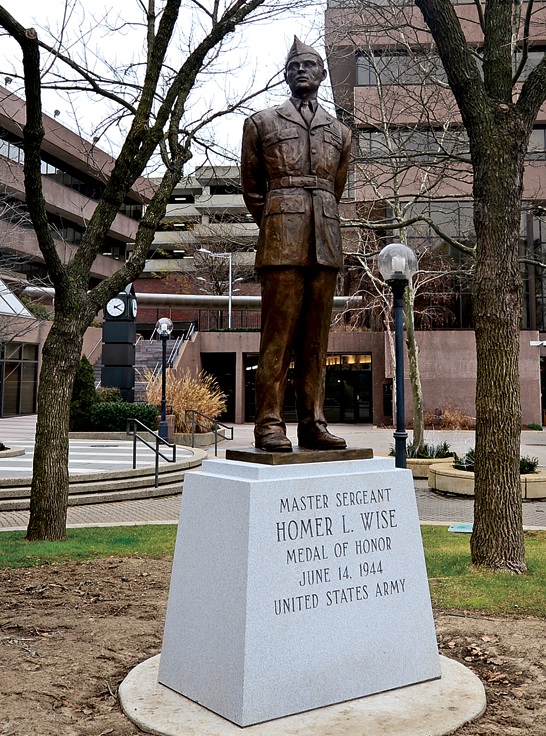
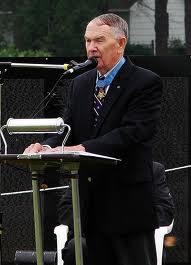
Paul W. Bucha, Medal of Honor recipient, Vietnam 1968, keynote speaker at the dedication of the statue of World War II Medal of Honor recipient Homer L. Wise, May 26, 2013, Stamford, CT
Company L, 142d Infantry Regiment, 36th Infantry Division
Statue erected in Veterans Park, Stamford, CT, December 18, 2024
Janice Mauro, Sculptor Photo: Hour Photo / Erik Trautman
The Homer L. Wise Memorial Committee
Podcasts
The Pritzker Military Library's Executive Producer, Ed Tracy, hosts live, monthly interviews with recipients of the Medal of Honor. Each program can be seen online at The Pritzker Military Library.






 Congressional Medal of Honor Society
 Congressional Medal of Honor Foundation
 Home of Heroes
 U.S Army Center of Military History
 U.S. Department of Defense
 The Pritzker Military Library
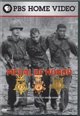

 Brings to life some of the rich stories that define America’s highest honor as it seeks to answer the broader question of what the Medal of Honor says about us as a nation. Read more...

 Subscribe in a reader