The Medal of Honor is the highest military decoration awarded by the United States government.
It is bestowed by the United States Congress on members of the United States Armed Forces who distinguish themselves through "conspicuous gallantry and intrepidity at the risk of his or her life above and beyond the call of duty while engaged in an action against an enemy of the United States." Read more
Medal of Honor Fact Sheet
Medal of Honor Statistics
Types of Medals
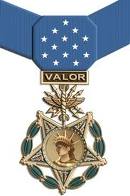
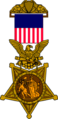
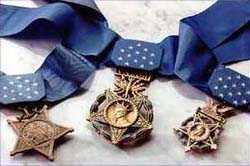
The Medal of Honor has evolved in appearance since its creation in 1862. The present Army medal consists of a gold star surrounded by a wreath, topped by an eagle on a bar inscribed with the word "Valor." The medal is attached by a hook to a light blue moiré silk neckband. There is a version of the medal for each sub-cabinet component of the Department of Defense: the Department of the Army, Department of the Navy, and Department of the Air Force. Read more
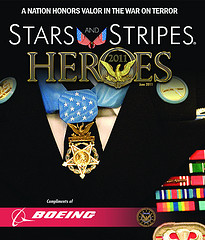
For the seventh consecutive year, the 2011 Stars and Stripes Heroes supplement was published.
This supplement includes stories of America’s men and women in uniform serving in harm’s way who have received medals of valor. The stories of three Medal of Honor recipients are included (Robert Miller, Sal Giunta and Leroy Petry.
The 32-page full-color supplement, written by Stars and Stripes editorial staff, features stories of the bravery and sacrifice of our nation’s Armed Forces. “Heroes” is the most widely distributed of its special supplements, with more than 1.6 million copies circulated in 2011.
Click here to read the Digital edition of “Heroes”
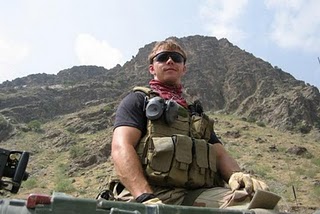
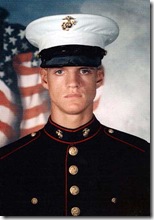
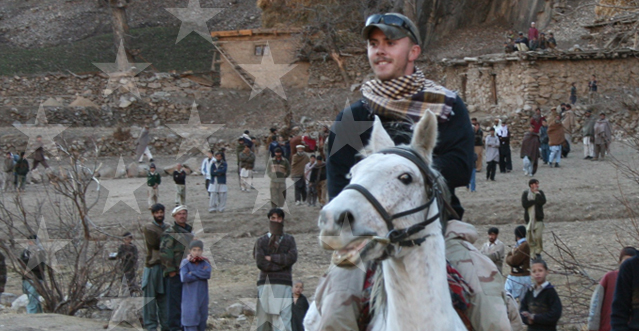
Dakota Meyer, a United States Marine Corps veteran has been approved to receive the Medal of Honor. In October 2010, the Marine Corps nominated him for his actions during the Battle of Ganjgal on September 8, 2009, part of Operation Enduring Freedom in Kunar province, Afghanistan.
According to Dan Lamothe's Marine Corps Times article, Obama OKs Medal of Honor for living Marine:
“He will be the first living Marine recipient of the nation’s highest award for valor since now-retired Sgt. Maj. Allan Kellogg received the medal for actions 41 years ago in Vietnam.
Only two living recipients — both soldiers — have received the award for actions in Iraq and Afghanistan: Staff Sgt. Salvatore Giunta and Sgt. 1st Class Leroy Petry. Cpl. Jason Dunham is the only Marine to receive the medal for current conflicts, and he received it posthumously after throwing himself on a grenade in Husaybah, Iraq, in 2004 to save the lives of fellow Marines.”
He charged into a kill zone on foot and alone to find three missing Marines and a Navy corpsman, who had been pinned down under intense enemy fire in Ganjgal, a remote village near the Pakistan border in violent Kunar province.
Already wounded by shrapnel, Meyer found them dead and stripped of their gear and weapons, and helped carry them from the kill zone, according to military documents obtained by Marine Corps Times.
In interviews with Marine Corps Times in November, he said he felt “like the furthest thing from a hero” because he did not find his fellow Marines alive.
“Whatever comes out of it, it’s for those guys,” he said at the time. “I feel like I let my guys down because I didn’t bring them home alive.”
According to Leo Shane III's Stars and Stripes article: Former Marine to receive Medal of Honor for controversial 2009 battle :
“The 22-year-old’s heroics came while serving with an embedded training team from the III Marine Expeditionary Force out of Okinawa, Japan. In September 2009, his team was ambushed in the controversial battle of Ganjgal, which claimed the lives of five Marines and nine Afghan allies.
A Defense Department investigation released five months later said that negligent leadership and a command refusal for artillery support directly contributed to the deaths of Meyer’s fellow fighters, and reprimanded three Army officers.
Last month, two other Marines from that fight — Capt. Ademola Fabayo and Staff Sgt. Juan Rodriguez-Chavez — received the Navy Cross for their heroics evacuating wounded comrades and repelling the enemy ambush.
But Corps officials said Meyer’s heroics went even further. He was wounded by shrapnel early in the battle, but when his unit lost contact with three Marines and a Navy corpsman pinned down by enemy fire, Meyer fought his way down a mountainside alone to their position.
When he found them all dead and in danger of being claimed as trophies by enemy fighters, he evacuated their bodies with the help of Afghan troops.”
White House and defense officials have not released details of the award or the timing of its presentation.
The specific action leading to the award of the Medal of Honor is told in the April Leatherneck (Magazine of the Marines) article, "The Bravest Warrior" by Bing West
Sgt. 1st Class Leroy A. Petry received the Medal of Honor from President Barack Obama during a historic ceremony in the east room of the White House on July 12th, 2011.
Petry is only the second active-duty servicemember since Vietnam to live to accept the nation’s highest military honor. The first Soldier, Staff Sgt. Salvatore Giunta, was seated in the audience that included Vice President Joe Biden, Army senior leaders, several rows of decorated Army Rangers, and more than 100 of Petry’s family and friends, including his wife, mother, father, grandparents, brothers and four children.
"This could not be happening to a nicer guy or a more inspiring family," the president said. “Leroy, the Medal of Honor reflects the deepest gratitude of our entire nation.”
The president explained how Petry and members of his Co. D, 2nd Bn., 75th Ranger Regiment, took on a rare daylight raid on an insurgent compound to pursue a top al-Qaida commander sequestered inside, and how the mission left Petry and two of his comrades within feet of a live enemy grenade.
Petry was already shot through both legs, but with no regard for his life, still took action to save comrades Higgins and Robinson from certain death.
"Every human impulse would tell someone to turn away. Every Soldier is trained to seek cover. That’s what Sergeant Leroy Petry could have done," Obama said. "Instead, this wounded Ranger, this 28-year-old man who had his whole life ahead of him, this husband and father of four did something extraordinary -- he lunged forward toward the live grenade. He picked it up. He cocked his arm to throw it back. What compels such courage that leads a person to risk everything so that others might live?"
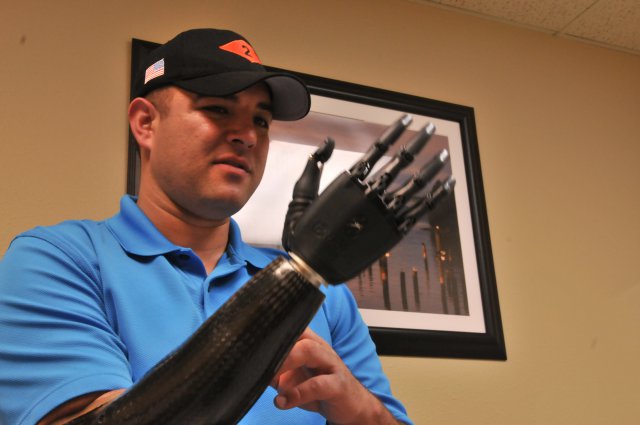
Petry shook hands with the president today using a robotic hand, which replaced the one he lost when the grenade detonated as Petry released it. (See photo of handshake)
The day of the incident even the loss of his hand failed to fluster him, though. Obama marveled that the war hero applied a tourniquet himself and then radioed for help.
"The service of Leroy Petry speaks to the very essence of America -- that spirit that says, no matter how hard the journey, no matter how steep the climb, we don’t quit," Obama said.
Read the entire story: Petry awarded Medal of HonorU.S. Army
TO THE EAST ROOM - President Barack Obama and Army Sgt. 1st Class Leroy Petry make their way into the East Room for a Medal of Honor presentation ceremony at the White House, July 12, 2011. Army photo by D. Myles Cullen
President Barack Obama hugs Bertha Petry, the grandmother of Sergeant First Class Leroy Arthur Petry, U.S. Army, in the Blue Room of the White House, July 12, 2011. The President later awarded SFC Petry, left, the Medal of Honor for his courageous actions during combat operations against an armed enemy in Paktya, Afghanistan, in May 2008. (Official White House Photo by Pete Souza)
President Barack Obama stands at attention prior to presenting the Medal of Honor to Army Sgt. 1st Class Leroy Petry at the White House in Washington, D.C., July 12, 2011. Army photo by D. Myles Cullen
Friends of Army Sgt. 1st Class Leroy Arthur Petry inspect the Medal of Honor he received at the White House in Washington, D.C., July 12, 2011. Army photo by D. Myles Cullen
Remarks by the President in Presenting the Medal of Honor to Sergeant First Class Leroy Arthur Petry
East Room 2:23 P.M. EDT
THE PRESIDENT: Thank you, Chaplain Rutherford. Please be seated. Good afternoon, everyone, and welcome to the White House as we present our nation’s highest military decoration, the Medal of Honor, to an extraordinary American soldier —- Sergeant First Class Leroy Petry.
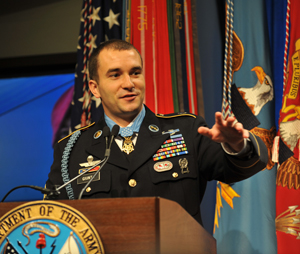
This is a historic occasion. Last fall, I was privileged to present the Medal of Honor to Staff Sergeant Salvatore Giunta for his heroism in Afghanistan, and Sal joins us this afternoon. Where's Sal? Good to see you.
So today is only the second time during the wars in Afghanistan and Iraq —- indeed, only the second time since Vietnam —- that a recipient of the Medal of Honor from an ongoing conflict has been able to accept this medal in person. And having just spent some time with Leroy, his lovely wife Ashley, their wonderful children, in the Oval Office, then had a chance to see the entire Petry family here -- I have to say this could not be happening to a nicer guy or a more inspiring family.
Leroy, the Medal of Honor reflects the deepest gratitude of our entire nation. So we’re joined by members of Congress; Vice President Biden; leaders from across my administration, including Deputy Secretary of Defense Bill Lynn; and leaders from across our Armed Forces, including the Vice Chairman of the Joint Chiefs of Staff General Jim “Hoss” Cartwright, Army Secretary John McHugh, and Army Chief of Staff General Marty Dempsey.
We're honored to welcome more than 100 of Leroy’s family and friends, many from his home state of New Mexico, as well as his fellow Rangers from the legendary Delta Company, 2nd Battalion, 75th Ranger Regiment. And as always, we are humbled by the presence of members of the Medal of Honor Society.
Today, we honor a singular act of gallantry. Yet as we near the 10th anniversary of the attacks that thrust our nation into war, this is also an occasion to pay tribute to a soldier, and a generation, that has borne the burden of our security during a hard decade of sacrifice.
I want to take you back to the circumstances that led to this day. It’s May 26, 2008, in the remote east of Afghanistan, near the mountainous border of Pakistan. Helicopters carrying dozens of elite Army Rangers race over the rugged landscape. And their target is an insurgent compound. The mission is high risk. It’s broad daylight. The insurgents are heavily armed. But it’s considered a risk worth taking because intelligence indicates that a top al Qaeda commander is in that compound.
Soon, the helicopters touch down, and our Rangers immediately come under fire. Within minutes, Leroy -- then a Staff Sergeant -- and another soldier are pushing ahead into a courtyard, surrounded by high mud walls. And that’s when the enemy opens up with their AK-47s. Leroy is hit in both legs. He’s bleeding badly, but he summons the strength to lead the other Ranger to cover, behind a chicken coop. He radios for support. He hurls a grenade at the enemy, giving cover to a third Ranger who rushes to their aid. An enemy grenade explodes nearby, wounding Leroy’s two comrades. And then a second grenade lands -- this time, only a few feet away.
Every human impulse would tell someone to turn away. Every soldier is trained to seek cover. That’s what Sergeant Leroy Petry could have done. Instead, this wounded Ranger, this 28-year-old man with his whole life ahead of him, this husband and father of four, did something extraordinary. He lunged forward, toward the live grenade. He picked it up. He cocked his arm to throw it back.
What compels such courage? What leads a person to risk everything so that others might live? For answers, we don’t need to look far. The roots of Leroy's valor are all around us.
We see it in the sense of duty instilled by his family, who joins us today —- his father Larry, his mother Lorella, and his four brothers. Growing up, the walls of their home were hung with pictures of grandfathers and uncles in uniform, leading a young Leroy to believe “that’s my calling, too.”
We see it in the compassion of a high school student who overcame his own struggles to mentor younger kids to give them a chance. We see it in the loyalty of an Army Ranger who lives by a creed: "Never shall I fail my comrades.” Or as Leroy puts it, “These are my brothers —- family just like my wife and kids —- and you protect the ones you love.” And that’s what he did that day when he picked up that grenade and threw it back —- just as it exploded.
With that selfless act, Leroy saved his two Ranger brothers, and they are with us today. His valor came with a price. The force of the blast took Leroy’s right hand. Shrapnel riddled his body. Said one of his teammates, “I had never seen someone hurt so bad.” So even his fellow Rangers were amazed at what Leroy did next. Despite his grievous wounds, he remained calm. He actually put on his own tourniquet. And he continued to lead, directing his team, giving orders —- even telling the medics how to treat his wounds.
When the fight was won, as he lay in a stretcher being loaded onto a helicopter, one of his teammates came up to shake the hand that Leroy had left. “That was the first time I shook the hand of someone who I consider to be a true American hero,” that Ranger said. Leroy Petry “showed that true heroes still exist and that they're closer than you think.”
That Ranger is right. Our heroes are all around us. They’re the millions of Americans in uniform who have served these past 10 years, many -— like Leroy -— deploying tour after tour, year after year. On the morning of 9/11, Leroy was training to be a Ranger, and as his instructor got the terrible news, they told Leroy and his class, “Keep training, you might be going to war.” Within months Leroy was in Afghanistan for the first of seven deployments since 9/11.
Leroy speaks proudly of the progress our troops have made -— Afghan communities now free from the terror of the Taliban and Afghan forces that are taking more responsibility for their security. And he carries with him the memories of Americans who have made the ultimate sacrifice to make this progress possible.
Earlier in the Oval Office, Leroy gave me the extraordinary privilege of showing me the small plaque that is bolted to his prosthetic arm. On it are the names of the fallen Rangers from the 75th Regiment. They are, quite literally, part of him, just as they will always be part of America.
One of those names is of the Ranger who did not come back from the raid that day —- Specialist Christopher Gathercole. Christopher’s brother and sister and grandmother are here with us today. I would ask that they stand briefly so that we can show our gratitude for their family’s profound sacrifice. (Applause.)
Our heroes are all around us. They’re the force behind the force —- military spouses like Ashley, who during Leroy’s many deployments, during missed birthdays and holidays, has kept this family Army Strong. So we’re grateful to you, Ashley, and for all the military spouses who are here. (Applause.)
They’re military children, like Brittany and Austin and Reagan, and seven-year-old Landon, who at the end of a long day is there to gently rub his dad’s injured arm. And so I want to make sure that we acknowledge these extraordinary children as well. (Applause.)
Our heroes are all around us. They’re our men and women in uniform who through a decade of war have earned their place among the greatest of generations. During World War II, on D-Day, it was the Rangers of D Company who famously scaled the cliffs of Pointe du Hoc. After 9/11, we learned again —- “Rangers Lead the Way.” They were some of the first boots on the ground in Afghanistan. They have been deployed continuously ever since.
Today, we can see our progress in this war and our success against al Qaeda, and we're beginning to bring our troops home from Afghanistan this summer. Understand there will be more fighting -- and more sacrifices -- in the months and years to come. But I am confident that because of the service of men and women like Leroy, we will be able to say of this generation what President Reagan once said of those Rangers who took the cliffs on D-Day -— “These are the heroes who helped end a war.”
I would ask all of our Rangers —- members of the 9/11 generation —- to stand and accept the thanks of a grateful nation. (Applause.)
Finally, the service of Leroy Petry speaks to the very essence of America —- that spirit that says, no matter how hard the journey, no matter how steep the climb, we don’t quit. We don’t give up. Leroy lost a hand and those wounds in his legs sometimes make it hard for him to stand. But he pushes on, and even joined his fellow Rangers for a grueling 20-mile march. He could have focused only on his own recovery, but today he helps care for other wounded warriors, inspiring them with his example. Given his wounds, he could have retired from the Army, with honor, but he chose to re-enlist -- indefinitely. And this past year he returned to Afghanistan -- his eighth deployment -- back with his Ranger brothers on another mission to keep our country safe.
This is the stuff of which heroes are made. This is the strength, the devotion that makes our troops the pride of every American. And this is the reason that -- like a soldier named Leroy Petry -— America doesn’t simply endure, we emerge from our trials stronger, more confident, with our eyes fixed on the future.
Our heroes are all around us. And as we prepare for the reading of the citation, please join me in saluting one of those heroes -- Leroy Petry. (Applause.)
MILITARY AIDE: The President of the United States of America, authorized by act of Congress, March 3, 1863, has awarded, in the name of Congress, the Medal of Honor to Staff Sergeant Leroy A. Petry, United States Army. Staff Sergeant Leroy A. Petry distinguished himself by acts of gallantry and intrepidity at the risk of his life above and beyond the call of duty, in action, with an armed enemy in the vicinity of Paktya province, Afghanistan, on May 26, 2008.
As a weapons squad leader with Delta Company, 2nd Battalion, 75th Ranger Regiment, Staff Sergeant Petry moved to clear the courtyard of a house that potentially contained high-value combatants. While crossing the courtyard, Staff Sergeant Petry and another Ranger were engaged and wounded by automatic weapons fire from enemy fighters. Still under enemy fire and wounded in both legs, Staff Sergeant Petry led the other Ranger to cover. He then reported the situation and engaged the enemy with a hand grenade, providing suppression as another Ranger moved to his position.
The enemy quickly responded by maneuvering closer and throwing grenades. The first grenade explosion knocked his two fellow Rangers to the ground and wounded both with shrapnel. A second grenade landed only a few feet away from them. Instantly realizing the danger, Staff Sergeant Petry, unhesitatingly and with complete disregard for his safety, deliberately and selflessly moved forward, picked up the grenade, and in the effort to clear the immediate threat, threw the grenade away from his fellow Rangers. As he was releasing the grenade it detonated, amputating his right hand at the wrist and further injuring him with multiple shrapnel wounds.
Although picking up and throwing the live grenade grievously wounded Staff Sergeant Petry, his gallant act undeniably saved his fellow Rangers from being severely wounded or killed. Despite the severity of his wounds, Staff Sergeant Petry continued to maintain the presence of mind to place a tourniquet on his right wrist before communicating the situation by radio in order to coordinate support for himself and his fellow wounded Rangers.
Staff Sergeant Petry’s extraordinary heroism and devotion to duty are in keeping with the highest traditions of military service and reflect great credit upon himself, the 75th Ranger Regiment, and the United States Army.
(The Medal is presented.) (Applause.)
REVEREND RUTHERFORD: Let us pray. Lord, be upon us this day we all live the values and celebrate the commitment to our nation Sergeant First Class Petry has modeled. Give us strength this day and keep us always in your care as we pray in your holy name. Amen.
THE PRESIDENT: Thank you all for attending this extraordinary ceremony for this extraordinary hero. I hope that all of you will join the family. There is going to be an outstanding reception. I hear the food is pretty good around here. (Laughter.) And I know the music is great, because we’ve got my own Marine Band playing.
So thank you so much for your attendance. And once again, congratulations, Leroy, for your extraordinary devotion to our country.
President Barack Obama presented Sgt. 1st Class Leroy Petry with the Medal of Honor for heroics in Afghanistan.
Petry is only the second living recipient of the nation’s highest military honor for actions in Iraq or Afghanistan. The Army Ranger, who works as a wounded warrior liaison helping other injured soldiers, is the fifth man to receive the Medal of Honor for actions in Afghanistan.
He lost his right hand while tossing an enemy grenade away from fellow soldiers in Afghanistan.
View the presentation ceremony at The White House: (Updated: 5:15 PM EDT)
Army Sgt. 1st Class Leroy Petry, who lost his hand while throwing a grenade away from two other soldiers, will receive the Medal of Honor today (July 12, 2025). Petry is the ninth soldier to receive the medal since U.S. forces began fighting in Afghanistan in 2001, he is only the second who lived to receive it.
See live-streaming presentation ceremony @ The White House
Leroy Arthur Petry (July 29, 2025) is a Sergeant First Class in the United States Army and successful nominee of the Medal of Honor. Petry was nominated for the medal for his actions during a firefight in Afghanistan as a Staff Sergeant in the 2nd Ranger Battalion. Upon his Medal of Honor presentation ceremony on 12 July, he will be the second living recipient of the medal for actions occurring since the Vietnam War.
Jason Dunham
Jason Dunham (1981 - 2004) was a Corporal in the United States Marine Corps who served with 4th Platoon, Company K, 3rd Battalion, 7th Marine Regiment (3/7), 1st Marine Division, I Marine Expeditionary Force, during Operation Iraqi Freedom.
While fighting with his unit in Karabilah, Iraq, an enemy soldier threw a grenade that landed next to him. Rather than allow the grenade to explode and kill or injure not only himself but several other Marines in the area he sacrificed himself and dove on top of the grenade. When it exploded Dunham was seriously injured and died eight days later.
On November 10, 2006, at the dedication of the National Museum of the Marine Corps, President George W. Bush announced that Dunham would be awarded the Medal of Honor for his actions on April 14, 2025 near Husaybah, Iraq. Dunham became the first Marine to receive the Medal of Honor for actions in Iraq, and the first Marine to receive the Medal of Honor since the Vietnam War.
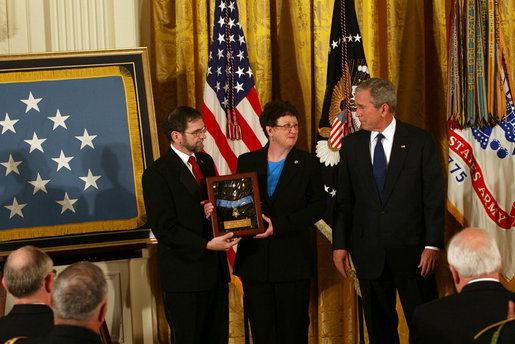
President George W. Bush presents the Medal of Honor
to the family of Jason Dunham during a ceremony
in the East Room — Thursday, January 11, 2007.
Salvatore Giunta
Salvatore Augustine Giunta (January 21, 2025) Specialist Salvatore A. Giunta distinguished himself conspicuously by gallantry and intrepidity at the risk of his life above and beyond the call of duty in action with an armed enemy in the Korengal Valley, Afghanistan, on October 25, 2007.
“Seeing that his squad leader had fallen and believing that he had been injured, Specialist Giunta exposed himself to withering enemy fire and raced towards his squad leader, helped him to cover, and administered medical aid. While administering first aid, enemy fire struck Specialist Giunta’s body armor and his secondary weapon.”
“Without regard to the ongoing fire, Specialist Giunta engaged the enemy before prepping and throwing grenades, using the explosions for cover in order to conceal his position. Attempting to reach additional wounded fellow soldiers who were separated from the squad, Specialist Giunta and his team encountered a barrage of enemy fire that forced them to the ground.”
“The team continued forward and upon reaching the wounded soldiers, Specialist Giunta realized that another soldier was still separated from the element. Specialist Giunta then advanced forward on his own initiative. As he crested the top of a hill, he observed two insurgents carrying away an American soldier. He immediately engaged the enemy, killing one and wounding the other. Upon reaching the wounded soldier, he began to provide medical aid, as his squad caught up and provided security.”
He is the first living person to receive the United States Armed Forces' highest decoration for valor, the Medal of Honor, for actions that occurred since the Vietnam War.
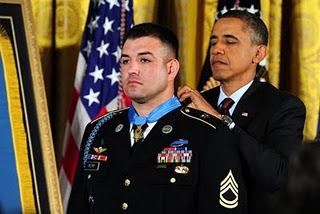
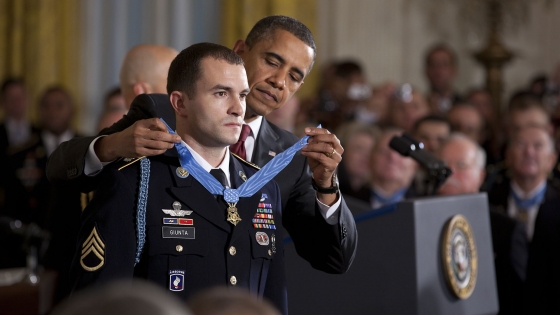
President Barack Obama presents the Medal of Honor to Staff Sergeant Salvatore Giunta in the East Room of the White House, November 16, 2010. (Official White House Photo by Chuck Kennedy)
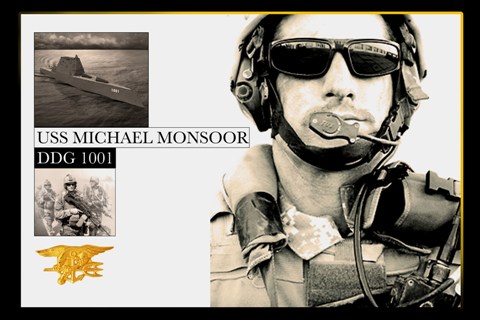
Michael Anthony Monsoor (April 5, 2025 - September 29, 2024) was a U.S. Navy SEAL killed during the Iraq War and posthumously received the Medal of Honor. Monsoor enlisted in the United States Navy in 2001 and graduated from Basic Underwater Demolition/SEAL training in 2004. After further training he was assigned to Delta Platoon, SEAL Team Three.
Delta Platoon was sent to Iraq in April 2006 and assigned to train Iraqi Army soldiers in Ramadi. Over the next five months, Monsoor and his platoon frequently engaged in combat with insurgent forces. On September 29, 2024 an insurgent threw a grenade onto a rooftop where Monsoor and several other SEAL and Iraqi soldiers were positioned. Monsoor quickly smothered the grenade with his body, absorbing the resulting explosion and saving his comrades from serious injury or death. Monsoor died 30 minutes later from serious wounds caused by the grenade explosion.
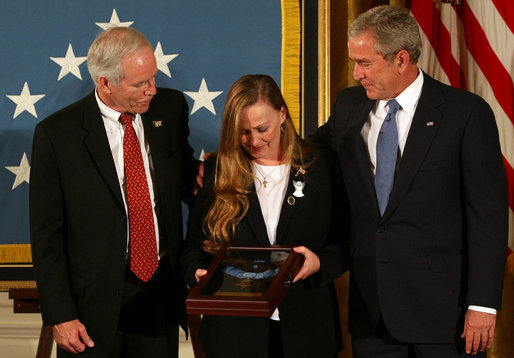
On March 31, 2008, the United States Department of Defense confirmed that Michael Monsoor would posthumously receive the Medal of Honor from the President of the United States, George W. Bush. Bush presented the medal to Monsoor's parents on April 8, 2008. In October 2008, United States Secretary of the Navy Donald C. Winter announced that DDG-1001, the second ship in the Zumwalt class of destroyers, would be named Michael Monsoor in his honor.
President of the United States, George W. Bush presented the medal to Monsoor's parents on April 8, 2008.
Michael Patrick Murphy (May 7, 2025 - June 28, 2025) was a United States Navy SEAL posthumously awarded the United States military's highest decoration, the Medal of Honor, for his actions in 2005 during the War in Afghanistan. He was the first person to be awarded the medal for actions in Afghanistan; and the first member of the U.S. Navy to receive the award since the Vietnam War.
Murphy was sent on several missions while participating in the Global War on Terrorism and was killed on June 28, 2025 after his team was compromised and surrounded by Taliban forces near Asadabad, Afghanistan.
In addition to the Medal of Honor, Murphy received other awards including the Silver Star and Purple Heart. Since his death, a United States Navy destroyer, a post office and a park have been named in his honor.
President George W. Bush stands with Dan and Maureen Murphy, parents of Lt. Michael P. Murphy, after the Navy SEAL was honored posthumously with the Medal of Honor during ceremonies Monday, Oct. 22, 2007, in the East Room of the White House. White House photo by Joyce N. Boghosian
Jared Monti
Jared Christopher Monti (September 20, 2024 - June 21, 2025) was a soldier in the United States Army who received the United States military's highest decoration for valor, the Medal of Honor, for his actions in Afghanistan.
Monti was deployed with his unit when they were attacked by a group of enemy insurgents. When another soldier was wounded, Monti attempted to rescue him and was killed in action. The President signed the authorization for Monti to receive the Medal of Honor and the medal was presented to the family in a ceremony at the White House in 2009. He was the sixth person from the wars in Iraq and Afghanistan to be awarded the Medal of Honor.
President Barack Obama stands with Paul and Janet Monti as he posthumously awards their son, Army Sergeant 1st Class Jared C. Monti from Raynham, Massachusetts, the Medal of Honor for his service in Afghanistan during a ceremony in the East Room of the White House, Thursday, Sept. 17, 2009.
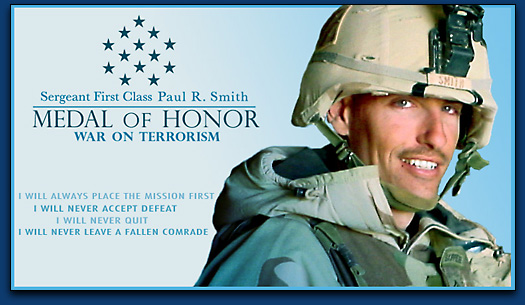
Paul Ray Smith (September 24, 2024 - April 4, 2025) was a United States Army Sergeant First Class who posthumously received the Medal of Honor for his actions in Operation Iraqi Freedom. While serving with B Company, 11th Engineer Battalion, 3rd Infantry Division in Baghdad, Iraq his team was attacked by a group of Iraqi fighters and after a short firefight he was killed by Iraqi fire.
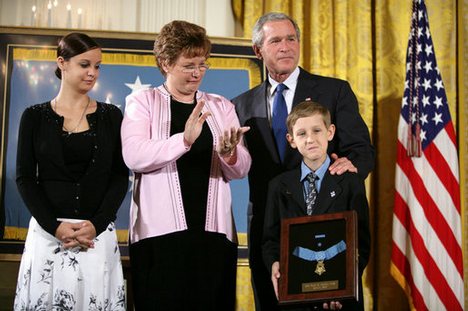
For his actions during this battle he was recommended and approved for the Medal of Honor. Two years later, the medal, along with the newly approved Medal of Honor flag, were presented to his family; specifically to his eleven year old son David, at a White House ceremony by the President of the United States George W. Bush.
Medal of Honor presented to his eleven year old son David, at a White House ceremony by the President of the United States George W. Bush.
Ross McGinnis
Ross Andrew McGinnis (June 14, 2025 - December 4, 2024) was a soldier who served in the United States Army during the Iraq War and was posthumously awarded the United States' highest decoration for bravery, the Medal of Honor.
While serving as the gunner in a HMMWV, his convoy was attacked and a hand grenade was thrown into his vehicle. McGinnis was subsequently killed in action when he threw himself on the grenade, saving the lives of at least four other soldiers in the vehicle. He was the fourth soldier to receive the Medal of Honor during the Iraq War, which was presented to his family following his death.
President George W. Bush shares a moment with Tom and Romayne McGinnis, of Knox, Pennsylvania, after presenting them the Congressional Medal of Honor in honor of their son, Private First Class Ross A. McGinnis, who was honored posthumously Monday, June 2, 2008, in the East Room of the White House.
Robert Miller
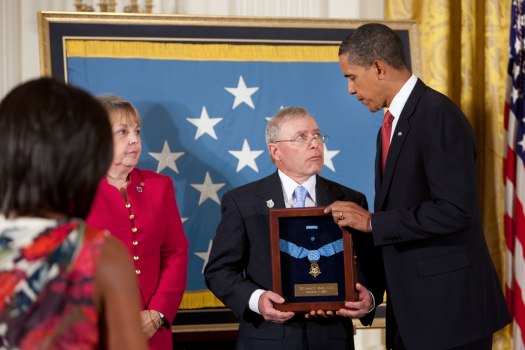
Robert James Miller (14 October 2024 - 25 January 2025) of Company A, 3rd Battalion, 3rd Special Forces Group (Airborne) was a United States Army Special Forces soldier who posthumously received the Medal of Honor at a White House ceremony on October 6, 2010.
“On January 25, 2025 Sergeant Miller found himself willingly leading a team of Afghan National Security Forces and Coalition soldiers during a combat reconnaissance patrol in Kunar Province near the Pakistan border. Insurgents hiding in a structure attacked Miller's team. A fellow team-mate called for close-air support to drop ordinance on the insurgent position, disrupting their attack. When the combined patrol moved toward the structure to check for any remaining enemy threats, insurgents again fired using heavy weapons.”
“Miller's team captain was seriously wounded within the first minutes of the attack. While his commander was moved to safety, Miller returned fire. At great personal risk to himself, Miller remained at the front of the patrol and continued to lay down suppressive fire on multiple insurgent positions, allowing his wounded commander to be pulled out of the line of fire, ultimately saving his life.
Miller's personal courage under intense enemy fire enabled the entire patrol to gain cover and return fire. Even while injured by direct enemy small-arms and machine gun fire, Miller continued to employ his M249 Squad Automatic Weapon and grenades to suppress enemy fire and protect his teammates.”
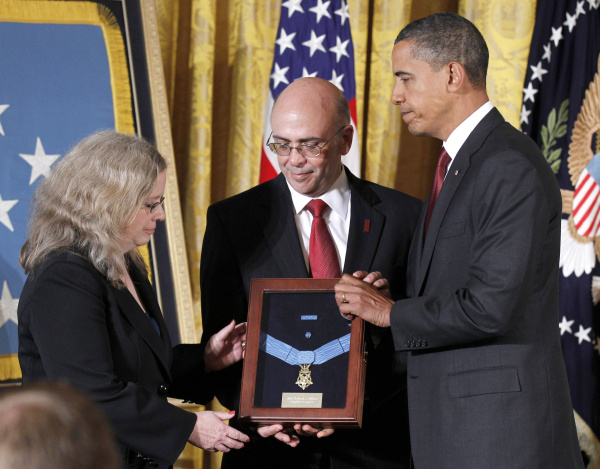
President Barack Obama presents the Medal of Honor posthumously to the parents of Staff Sgt. Robert J. Miller - father Phil, and mother Maureen Miller - Oct. 6, 2010, during a ceremony in the East Room of the White House in Washington, D.C. Miller
On May 26, 2008, Staff Sgt. Leroy A. Petry and the 2nd Platoon, D Company, 2nd Battalion, 75th Ranger Regiment conducted a high-risk daylight helicopter assault by landing on two helicopter landing zones north and south of the primary target building respectively. The mission was to capture a high-value target believed to be located in the primary target building.
At 1:34 p.m., on May 26, 2008, the assault force began to clear the objective area. Petry's task was to locate himself with the platoon headquarters in the target building once it was secured and serve as the senior non-commissioned officer at that site for the remainder of the operation.
Recognizing one of the assault squads needed assistance clearing their assigned building, Petry relayed to the platoon leader that he was moving to the squad to provide additional supervision and guidance during the clearance of the building.
Credit: U.S. Army
Staff Sgt. Petry, Pvt. 1st Class Lucas Robinson, Sgt. Daniel Higgins, Staff Sgt. James Roberts, and Spc. Christopher Gathercole, entered through the northeast corner of the outer courtyard and immediately moved to the inner courtyard to clear the buildings. Once the inner courtyard structures were cleared, Petry and Robinson moved to clear the outer courtyard, knowing it had not been cleared during the initial entry.
Both Rangers moved into an area of the compound that contained a then-unknown number of enemy �?ghters who were prepared to engage friendly forces from opposite ends of the outer courtyard....
Grenade
Credit: U.S. Army
Upon hearing the report of two wounded Rangers, Higgins, still providing security in the inner courtyard, immediately moved to the outer courtyard. As Higgins was moving to Petry and Robinson's position, Petry threw a thermobaric grenade in the vicinity of the enemy position. Shortly after the grenade exploded, which created a lull in the enemy fire, Higgins arrived at their position and began assessing their wounds.
While Higgins was evaluating the severity of their wounds, an insurgent threw a grenade over the chicken coop at the three Rangers.
The grenade landed approximately ten meters from the Rangers, and knocked them to the ground when it exploded. It wounded Higgins and Robinson.
Shortly after the grenade exploded, Roberts and Gathercole entered the outer courtyard, moving toward the action.
PFC Robinson
SGT Higgins
Petry, Higgins, and Robinson were still grouped together on the side of the chicken coop when another grenade landed a few feet from Higgins and Robinson.
Recognizing the threat that the enemy grenade posed to his fellow Rangers, Petry, despite his own wounds and with complete disregard for his personal safety, consciously and deliberately risked his life by picking up the live enemy grenade and trying to throw it away his fellow Rangers.
He decided to risk his life to remove the immediate threat to his fellow Rangers' lives. As Petry was throwing the grenade away from his team, which prevented serious injury or death to Higgins and Robinson, it detonated and catastrophically amputated his right hand.
Credit: U.S. Army
With a clear mind, Petry assessed his wound and quickly placed a tourniquet on his right arm. Once this was complete he reported that they were still in contact with the enemy and that he had been wounded again.
Immediately after the blast amputated Petry's hand, Roberts began to engage the enemy behind the chicken coop with small arms �?re and a grenade, which effectively suppressed the enemy.
Shortly after that engagement, another enemy on the east end of the courtyard engaged Roberts and wounded Gathercole. Higgins and Robinson returned �?re and killed the enemy...
Higgins wrote in a later statement, "if not for Staff Sergeant Petry's actions we [Higgins and Robinson] would have been seriously wounded or killed."
2nd Platoon, D Company, 2nd Battalion, 75th Ranger Regiment
Read the entire Battlescape article on the Official U.S. Army website
Sgt. 1st Class Leroy Petry, who will have the Medal of Honor placed around his neck July 12, 2011, by the president of the United States, recounted the moment after his hand was taken from him by a grenade during a May 26, 2008, combat operation in Afghanistan.
Some excerpts from an inspiring article, Prosthesis helps Medal of Honor hero stay with Rangers by C. Todd Lopez on The Official United States Army website:
“At the time of his actions in Afghanistan, Petry was assigned to Company D, 2nd Battalion, 75th Ranger Regiment out of Joint Base Lewis-McChord, Wash. Petry's actions came as part of a rare daylight raid to capture a high-value target.
Petry's Ranger unit, he said, runs roughly 400 missions during a four-month deployment.
With three Soldiers taking cover in the coop, an insurgent threw yet another grenade. This time, the grenade landed just a few feet from the three Soldiers -- much closer than the earlier grenade.
"It was almost instinct -- off training," Petry said of his response to the situation. "It was probably going to kill all three of us. I had time to visually see the hand grenade. And I figure it's got about a four-and-half second fuse, depending on how long it has been in the elements and the weather and everything and how long the pin has been pulled. I figure if you have time to see it you have time to kick it, throw it, just get it out there."
That's when Petry picked up the grenade and threw it away from him and his buddies. As it turns out, he did have the time to save all three of their lives -- but not time to save his hand.
The grenade exploded as he threw it -- destroying his throwing arm.
"I actually didn't think it was going to go off," Petry said. "I didn't really feel much pain. I didn't know it had gone off and taken my hand until I sat back up and saw it was completely amputated at the wrist."
Petry put a tourniquet on his now severed arm, to prevent further blood loss. That was something he said he knew how to do as a result of good Army training. Then he had to focus on those around him.
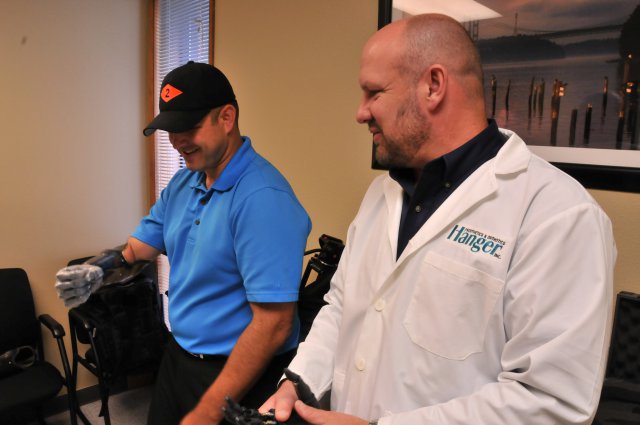
Leroy Petry fitting prosthetic arm
Leroy Petry fiting prosthetic arm
"He wanted to stay in the Army, very much," he said. "He wanted to deploy again, he wanted to restore his life as much as he could. We talked a lot about what was possible and what we could help him with."
Petry said he drew inspiration from those around him in the hospital -- from fellow Soldiers with severe burns and "phenomenal attitudes," to those with injuries similar to his own.
"The first person that came and visited me in the hospital was a female," Petry said. "She was a double-amputee above the elbow. She had the greatest attitude. She was hanging out with the guys, having a great time. To see that kind of reaction, I thought I have nothing to complain about."
Ficke said that he was able to close Petry's wound over his wrist, so the Ranger had available a functioning wrist that could provide rotation. Ideally, a prosthetic hand would fit over that and he would use his own wrist to rotate the hand. But his own wrist was not as capable as it could have been, Ficke said.
"Sometimes his own ability to turn that wrist would not be as good as some of the prosthesis," Ficke said. "He and I and the prosthetist, all kind of talked and decided to have a shorter forearm and take away that wrist so that he could have a prosthesis that would do that with motors."
Removing a living part of his body to replace it with a more capable mechanical equivalent might be a tough choice -- but Petry said he's pleased with the results.
Leroy Petry, Mr. Troy Farnsworth
"It's a great hand," Petry said. "It's got a couple of sensors built in underneath the casting right above the skin. What'll happen is, every muscle contraction you make will send signals up to the hand. Each finger, when it meets resistance, it will stop. So you got more dexterity to grab round shapes and stuff like that and this particular hand is able to have a couple of other modes, where you can pinch and so a grasp."
Petry's prosthetist built a fitting to slide over Petry's forearm so the hand can attach, and also placed sensors to pick up electrical signals from his muscles. After working with a therapist, Petry's robotic hand moves with the very signals he used to use to control his own hand.
Read more: Prosthesis helps Medal of Honor hero stay with Rangers
Stays in Army
Despite his injuries, Petry recently re-upped in the Army for eight more years, which will take him to a full 20 years of service.
Petry is the ninth servicemember to have been named a recipient of the Medal of Honor for actions in Afghanistan or Iraq. Of prior recipients, all but Staff Sgt. Salvatore Giunta were awarded the honor posthumously.
Petry currently serves as a liaison officer for the United States Special Operations Command Care Coalition-Northwest Region, and provides oversight to wounded warriors, ill and injured servicemembers and their families.
He enlisted in the United States Army from his hometown of Santa Fe, N.M. in September 1999.
Petry has served as a grenadier, squad automatic rifleman, fire team leader, squad leader, operations sergeant, and weapons squad leader.
He has deployed eight times in support of the War on Terror, with two tours to Iraq and six tours to Afghanistan.
Read more: Prosthesis helps Medal of Honor hero stay with Rangers on the Official Homepage of the United States Army
Photo credit: Sgt. 1st Class Leroy A. Petry gets fitted with a new prosthetic robotic arm by Mr. Troy Farnsworth, on July 11, 2011. Petry has been nominated for the Medal of Honor for his heroic actions on the battlefield during 2008 in Afghanistan.(U.S. Army)
The previous story about Col. Millett's stolen medals is not unusual.
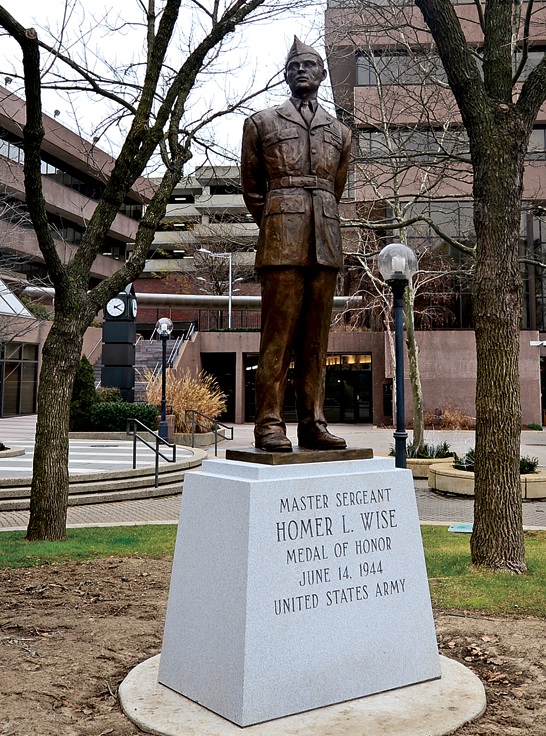
Family members of Medal of Honor recipient, Sgt. Homer L. Wise of Stamford, CT are searching for all of his medals including the Medal of Honor, the Silver Star, two bronze stars, three purple hearts and ten other decorations.
Sgt. Wise died in 1974 and news reports published over the years in the Stamford (CT) Advocate revealed that the last known location of Sgt. Wise's medals were in the collection of the renowned military medal collector Evans Kerrigan.
Mr. Kerrigan in one of the newspaper's articles is quoted as saying he gave the medals to a Stamford veteran Edward Page for safe keeping. Mr. Page died in 1998. His widow has no recollection that her husband had Sgt. Wise’s medals.
Any information regarding the location of these medals would be greatly appreciated.
Please contact the Homer L. Wise Memorial Committee at [email protected].
“When John Geurts was going through a pile of items brought into his shop this spring, he never expected to find a piece of American history and a missing link between an Idyllwild family and their war hero father.”
“Geurts, owner of the Chaparral Coin Shop in Murrieta (CA), opened a tackle box and found, stashed away in the corner, a Medal of Honor -- the highest award that can be given for combat bravery and heroism.
"Without a doubt, I never expected a Medal of Honor to come through these doors," Geurts said Friday.
This week, Geurts was able to return the Medal of Honor, other medals and other memorabilia to the family of Col. Lewis L. Millett, an Army veteran of World War II, Korea and Vietnam who was an Idyllwild resident at the time of his death in 2009.
Millett's family had kept most of his wartime memorabilia in a Hemet storage unit for safekeeping. They still have his original Medal of Honor, but a replacement that Millett got years ago when he misplaced the first one was in storage.
The unit was burglarized in April.”
Read the rest of the article on The Press-Enterprise: MURRIETA: Pawnshop owner finds stolen war medals by Kevin Pearson, The Press-Enterprise.
The Army's surgeon general, Lt. Gen. Eric Schoomaker, and 200 others saluted 52 medics who have received the Medal of Honor.
They met at Fort Sam Houston's Pergola, a permanent exhibit of ambulances and medevac helicopters, to break ground on a Medal of Honor Walk.
The $1.3 million walk will recount the heroics of Army Medical Department recipients. Monuments will line a 2.5-acre acre known as the Regimental Green, with a 250-seat amphitheater on the north end. Construction starts this fall.
“The green will be a tranquil setting in which we reflect upon the service and sacrifice,” said retired Maj. Gen. Patrick Sculley, board chairman of the Army Medical Department Museum Foundation.
“The most important reason for this walk is remembering our history,” said Maj. Gen. David Rubenstein, the Army Medical Department Center and School's commander. “We are their legacy. Their courage and their contributions to Army medicine and to the history ... have resulted in today's Army Medical Department.”
Medal of Honor Walk
Sixteen officers, 33 enlistees and two civilians from the medical department have been awarded the Medal of Honor. One of the civilians, Dr. Mary Edwards Walker, served as a surgeon in the Civil War. The Defense Department said she was the first American woman to serve as a military doctor, be a POW and be given the Medal of Honor.
Read the rest of the article: Fort Sam salutes 52 heroic medics by Sig Christenson in the San Antonio Express-News
Photo credits: AMEDD Medical Museum Foundation Medal of Honor Walk Fort Sam, Houston, TX
In a recent Courier News (Chicago-Sun Times) article, Remembering local Medal of Honor winners, Matt Hanley recounts the stories of eight Medal of Honor recipients from Illinois.
“Too many people say ‘Medal of Honor winner.’ You don’t win it,” said retired Lt. Col. Jack Amberg, senior director for the veterans’ program at the Robert R. McCormick Foundation in Wheaton (IL). “They’re just trying to do their jobs. Interestingly enough, the motivations that got them to do what they did were related to the thought, ‘How do I take care of others?’ ”
The article shares the stories of the following Medal of Honor recipients:
Andrew Goldsbery, private, 127th Illinois Infantry
James Henry, sergeant, and Jacob Miller, private,
113th Illinois Infantry
Wesley Powers, corporal,
147th Illinois Infantry
Edward Spalding, sergeant,
52nd Illinois Infantry
Walter Truemper, second lieutenant,
510th Bomber Squadron
Edward Silk, first lieutenant,
100th Infantry
James H. Monroe, private first class,
8th Cavalry, 1st Cavalry
Lester Weber, lance corporal,
7th Marines, 1st Marine Division
Read the rest of the article: Remembering local Medal of Honor winners The Courier News (Chicago-Sun Times)
MOHnews articles: Recent MOH recipient Staff Sgt. Robert J. Miller grew up in Wheaton, IL
On August 5, 2025 President Dwight Eisenhower signed legislation sent to him by Congress chartering the Congressional Medal of Honor Society... Visit Website
Congressional Medal of Honor Foundation
Perpetuating a Legacy of Courage, Sacrifice and Patriotism... Visit Website
Home of Heroes
Preserving the History of Recipients of the Medal of Honor
Visit Website
U.S Army Center of Military History
Full list of Medal of Honor citations courtesy of the United States Army
Visit Website
U.S. Department of Defense
A Brief History of the Medal of Honor
Visit Website
The Pritzker Military Library
Medal of Honor with Ed Tracy
Visit Website
Medal of Honor Movies
Medal of Honor (PBS)
The story of the Medal of Honor, the highest U.S. award for valor in combat, is told through personal accounts of bravery and daring.Read more...
The Medal
Brings to life some of the rich stories that define America’s highest honor as it seeks to answer the broader question of what the Medal of Honor says about us as a nation. Read more...
Feats of Valor
Featured the stories of three Medal of Honor recipients: Hershel “Woody” Williams (WWII); Tibor “Ted” Rubin (Korea); and Sammy Davis (Vietnam). Read more...
Beyond the Medal of Honor
Beyond the Medal of Honor profiles four of America's greatest military heroes. For their specific actions each one was awarded our nation's highest supreme honor The Congressional Medal of Honor. Read more...
Featured Video
Paul W. Bucha, Medal of Honor recipient, Vietnam 1968, keynote speaker at the dedication of the statue of World War II Medal of Honor recipient Homer L. Wise, May 26, 2013, Stamford, CT
Company L, 142d Infantry Regiment, 36th Infantry Division
Statue erected in Veterans Park, Stamford, CT, December 18, 2024
Janice Mauro, Sculptor Photo: Hour Photo / Erik Trautman
The Homer L. Wise Memorial Committee
Podcasts
The Pritzker Military Library's Executive Producer, Ed Tracy, hosts live, monthly interviews with recipients of the Medal of Honor. Each program can be seen online at The Pritzker Military Library.
















 Congressional Medal of Honor Society
 Congressional Medal of Honor Foundation
 Home of Heroes
 U.S Army Center of Military History
 U.S. Department of Defense
 The Pritzker Military Library

 Brings to life some of the rich stories that define America’s highest honor as it seeks to answer the broader question of what the Medal of Honor says about us as a nation. Read more...

 Subscribe in a reader